
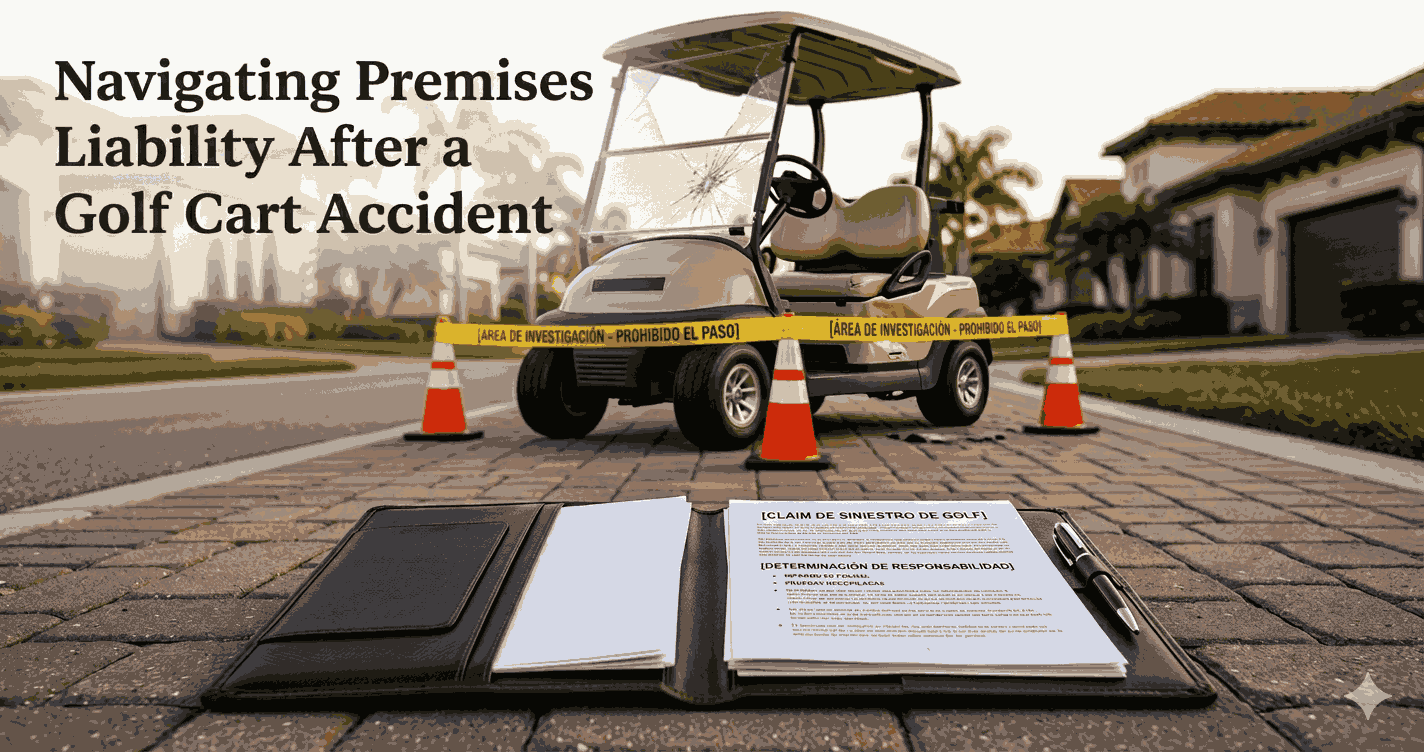
When you think of premises liability, your mind probably jumps to classic “slip-and-fall” scenarios—a wet floor in a grocery store or an icy sidewalk outside a retail shop. But premises liability covers a much broader legal landscape, including recreational properties like golf courses, country clubs, and luxury vacation resorts.
When a 1,000-pound golf cart crashes, rolls over, or strikes a pedestrian on a commercial property, determining who pays for the resulting medical bills and trauma often comes down to the core principles of premises liability law.
If you or a loved one has been injured in a golf cart mishap, understanding how property owner negligence intersects with your right to financial recovery is essential. Let’s break down exactly how these claims work.
What Is Premises Liability in a Golf Cart Context?
Premises liability is the legal framework holding property owners, managers, and operators financially accountable for accidents that happen on their land due to unsafe conditions.
In the eyes of the law, when you pay green fees at a golf course or check into a resort, you are legally classified as a business invitee. This status grants you the highest level of legal protection. Property owners owe you a strict duty of care. They are required to actively inspect the property, maintain their equipment, fix known hazards, and warn guests of any hidden dangers.
To win a premises liability lawsuit after a golf cart accident, your legal team must prove four basic elements:
-
Duty: The property owner had a legal obligation to keep the premises safe for you.
-
Breach: The owner breached that duty by allowing a dangerous hazard to exist.
-
Causation: This specific, neglected hazard directly caused your golf cart accident or injury.
-
Damages: You suffered real, measurable losses, such as emergency medical costs, lost wages, or physical suffering.
Common Grounds for a Premises Liability Claim
Golf cart accidents rarely happen in a vacuum. When a property owner fails to manage their infrastructure or fleet responsibly, they open themselves up to serious legal exposure. Premises liability claims involving golf carts usually stem from three main categories of corporate neglect.
1. Negligent Maintenance of Infrastructure and Cart Paths
A golf course or resort must design and maintain its pathways to safely handle vehicle traffic. Nature is constantly changing, meaning property infrastructure requires continuous upkeep.
A property owner can be held liable if a crash is triggered by:
-
Severe Path Defects: Deep, un-repaired potholes, crumbling concrete shoulders, or large tree roots cracking through asphalt walkways that cause a cart to flip or lose control.
-
Structural Failures: Rotting timber or un-reinforced support beams on small bridges spanning streams or ravines that collapse under a cart’s weight.
-
Hidden Walking Traps: Deep, obscured holes or drop-offs immediately adjacent to the path that completely lack safety barriers or reflective warning markers.
2. Failure to Provide Adequate Traffic Warning Signage
Golf carts do not handle steep inclines or sharp turns the same way standard cars do—they lack doors, airbags, and sophisticated stability control.
If a property has a notoriously dangerous geographical feature, management must install clear signage. A property owner faces liability if an accident occurs due to a lack of highly visible warning signs before:
-
Extremely steep, slick downhill slopes or blind curves hidden by overgrown landscaping.
-
Intersections where pedestrian walkways directly cross fast-moving cart paths.
-
Sudden drop-offs, cliffs, or deep water hazards situated right next to a driving path.
[Unmarked Sharp Corner] ──> [Driver Swerves Unexpectedly] ──> [Cart Tips into Drop-off] ──> [Owner Liable for Lack of Signage]
3. Negligent Fleet Maintenance (The Dangerous Instrumentality)
If the property owner provides or rents the golf cart directly to you, the vehicle itself is considered part of the “premises.” Management warrants that their rental fleet is mechanically sound.
Because fleet carts endure brutal, back-to-back daily usage by hundreds of different operators, properties must implement rigorous maintenance logs. A resort or golf course faces a strong negligence claim if an inspection reveals:
-
Worn Brake Lines: Brake pads or fluid levels neglected for months, causing total brake failure on a hill.
-
Bald Tires: Tires worn down completely smooth, causing the vehicle to slide out of control on wet morning grass or slick concrete pool decks.
-
Loose Steering Linkages: Un-repaired slack in the steering column that makes it impossible for a driver to successfully avoid a hazard.
Overcoming the “Inherent Risk” Defense
If you file a claim against a golf course or resort, their insurance adjusters will almost certainly try to deny it by using the assumption of risk defense. They will argue that by stepping onto a golf course or renting a cart, you willingly accepted the normal, inherent dangers of the sport—such as getting struck by an errant ball or driving on uneven turf.
However, premises liability laws draw a clear line between inherent sports risks and owner negligence.
While getting hit by a stray shot from a nearby golfer is generally an inherent risk of the game, driving over a rotting wooden bridge that collapses is not an inherent risk. A waiver or assumption of risk defense cannot legally shield a business from gross negligence or a reckless disregard for human safety. If management knew a hazard existed and chose to ignore it, any signed liability waiver will typically be thrown out by a judge.
Steps to Protect Your Legal Rights After a Crash
To successfully hold a commercial property owner responsible under premises liability, you need immediate, undeniable proof of the dangerous condition before the property owner has a chance to clean up or fix the scene.
1.Take Immediate Photographic Evidence:Capture the Hazard.
Comparative Fault: How Your Actions Impact Compensation
Many states follow a legal rule called comparative negligence. This means that if you were partially responsible for your own accident, your final financial payout will be reduced by your percentage of fault.
For example, if a golf course failed to repair a major pothole on a cart path, but the insurance company proves you were actively texting or driving while intoxicated when you hit it, a court might find you 40% at fault. If your total medical bills and suffering equal $100,000, your final settlement will be adjusted down to $60,000.
Always operate golf carts responsibly, follow posted speed limits, and keep your eyes on the path ahead to protect both your physical safety and your legal claim.
Have you ever noticed a dangerous pothole, a broken cart, or a total lack of safety signs while visiting a resort or golf course? How did the property owners handle it? Share your thoughts and experiences in the comments section below, and share this article on social media to help keep your friends and family safe on their next outing!
References
-
Restatement (Third) of Torts: Liability for Physical and Emotional Harm (2024). Standard of care and liability analysis for commercial property owners to business invitees.
-
Journal of Legal Aspects of Sport (2023). Assessing the limitations and enforceability of liability waivers involving low-speed recreational vehicles and gross mechanical negligence.
-
National Safety Council Report on Low-Speed Vehicles (2025). Infrastructure design hazards, cart path maintenance, and safety compliance metrics on commercial properties.
