

Golf carts are a common sight across South Carolina, from coastal vacation spots to master-planned communities and local golf courses. While these vehicles offer a relaxed way to travel, their popularity has led to an increase in safety concerns and accidents. Because golf carts are often top-heavy and lack the structural safety features of traditional automobiles, collisions can result in serious injuries, including traumatic brain injuries, broken bones, and whiplash.
If you or a loved one has been injured in a golf cart accident, understanding South Carolina’s specific regulations and legal landscape is essential for protecting your rights and securing fair compensation.
Understanding South Carolina Golf Cart Laws
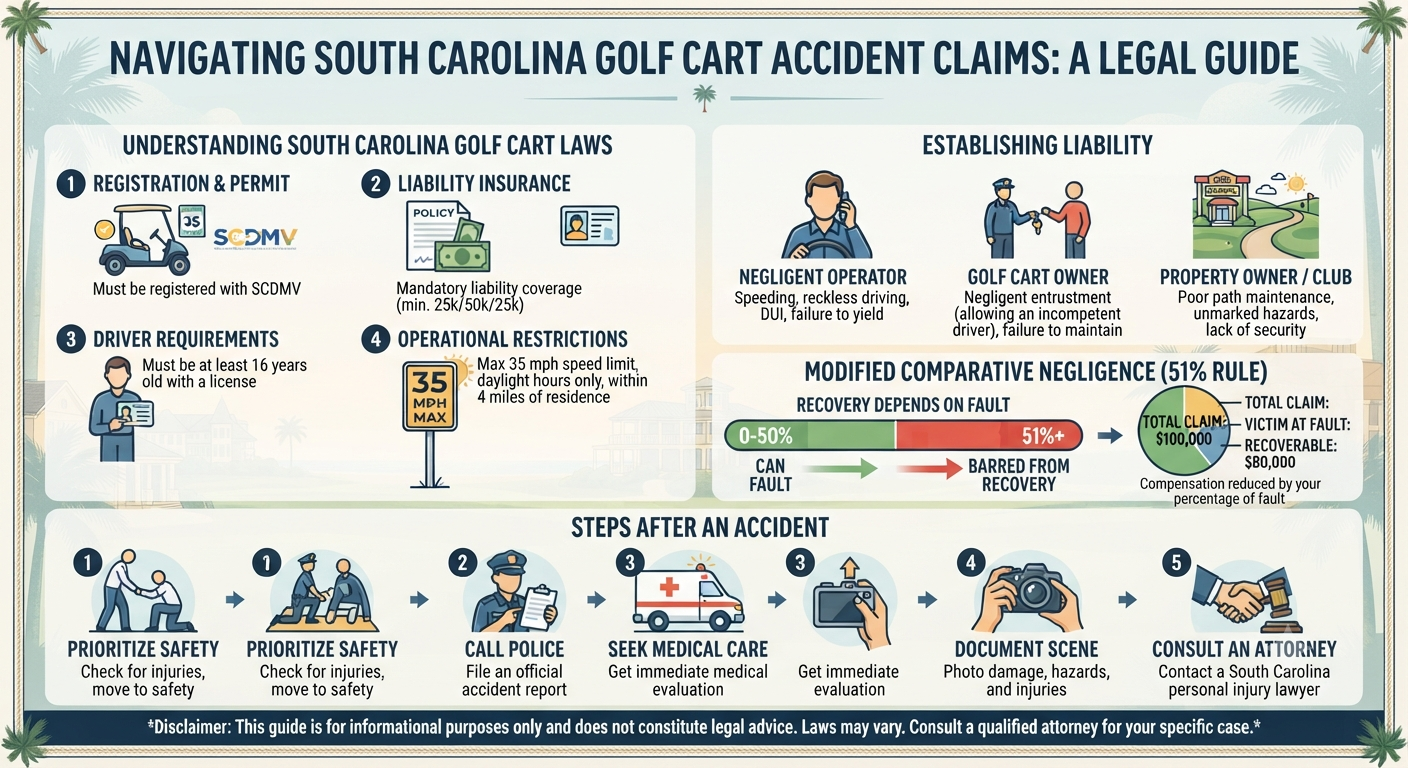
South Carolina has established clear regulations for operating golf carts on public streets and highways. Before taking a golf cart onto a public road, operators must adhere to a strict checklist:
-
Registration and Permitting: Golf carts must be registered with the South Carolina Department of Motor Vehicles (SCDMV) and display a valid permit decal.
-
Liability Insurance: Proof of liability insurance is mandatory for operating on public roads. South Carolina requires minimum liability limits of $25,000 per person and $50,000 per accident for bodily injury, plus $25,000 for property damage.
-
Driver Requirements: Operators must be at least 16 years old and possess a valid driver’s license, which must be in their possession while driving on public highways.
-
Operational Restrictions:
-
Golf carts may only be operated on secondary highways or streets with a posted speed limit of 35 mph or less.
-
Operation is restricted to daylight hours.
-
The cart must remain within four miles of the registered address or the entrance to a gated community.
-
-
Passenger Safety: Children under the age of 12 are required to wear a fastened seat belt when the golf cart is operated on public streets and highways.
Failure to follow these regulations not only poses safety risks but can also complicate a future injury claim if liability is disputed.
Establishing Liability in a Golf Cart Accident
To succeed in a personal injury claim, you must generally prove that the other party owed you a duty of care, violated that duty through their actions (or failure to act), and that this violation directly caused your injuries and recognizable damages.
Potential liable parties may include:
-
The Golf Cart Operator: If the driver was reckless, intoxicated, speeding, or failed to yield.
-
The Golf Cart Owner: If they knowingly entrusted the cart to an unlicensed or incompetent driver (negligent entrustment) or failed to maintain the vehicle.
-
Property Owners or Clubs: If the accident occurred on a golf course or at a country club, the business may be liable if the injury resulted from their negligence, such as poor path maintenance or hazardous property conditions.
Modified Comparative Negligence
South Carolina follows the modified comparative negligence rule. This means that if you are partially at fault for the accident, your ability to recover compensation is not automatically barred, provided your share of the fault is not greater than the other party’s.
-
The 51% Bar Rule: You can recover compensation as long as you are 50% or less at fault. If you are found to be 51% or more responsible, you are barred from recovering any damages.
-
Reduction of Damages: If you are found partially at fault (e.g., 20%), your total recovery will be reduced by that percentage. For example, in a $200,000 claim, if you are found 20% responsible, you would receive $160,000.
Insurance companies often attempt to shift blame onto the victim to reach the 51% threshold and avoid paying the claim. An experienced attorney can help protect your interests by carefully evaluating the evidence and fighting against unfair fault assessments.
Important Deadlines: Statute of Limitations
It is critical to act quickly after an accident. In South Carolina, the general statute of limitations for filing a personal injury lawsuit is three years from the date of the injury.
-
Discovery Rule: The clock typically starts on the date of the accident, though the “discovery rule” may apply if the injury or its cause was not immediately apparent.
-
Claims Against the Government: If your accident involved a government agency or employee, you may have a shorter window—as little as two years—to file a claim under the South Carolina Tort Claims Act.
-
Exceptions: Exceptions exist for cases involving minors (who may have until after their 18th birthday to file) or those with mental incapacity.
Missing these deadlines can result in the court dismissing your case, causing you to forfeit your right to compensation.
Reference
-
South Carolina Department of Public Safety (SCDPS): Golf Cart Law.
-
South Carolina Department of Motor Vehicles (SCDMV): Golf Carts Registration and Permit Requirements.
-
Steinberg Law Firm: South Carolina Golf Cart Accidents – Liability and Comparative Negligence.
-
McDougall Law Firm: Statute of Limitations for Personal Injury Cases in South Carolina.
-
McCravy, Newlon, & Clardy Law Firm: Understanding South Carolina Comparative Negligence Laws.
-
Roden Law: Comparative Negligence and the 51% Bar Explained.
-
Farm Bureau Insurance: Golf Cart Safety and Coverage Considerations.
-
The Morgano Agency: Golf Cart Insurance in South Carolina: FAQ.
