

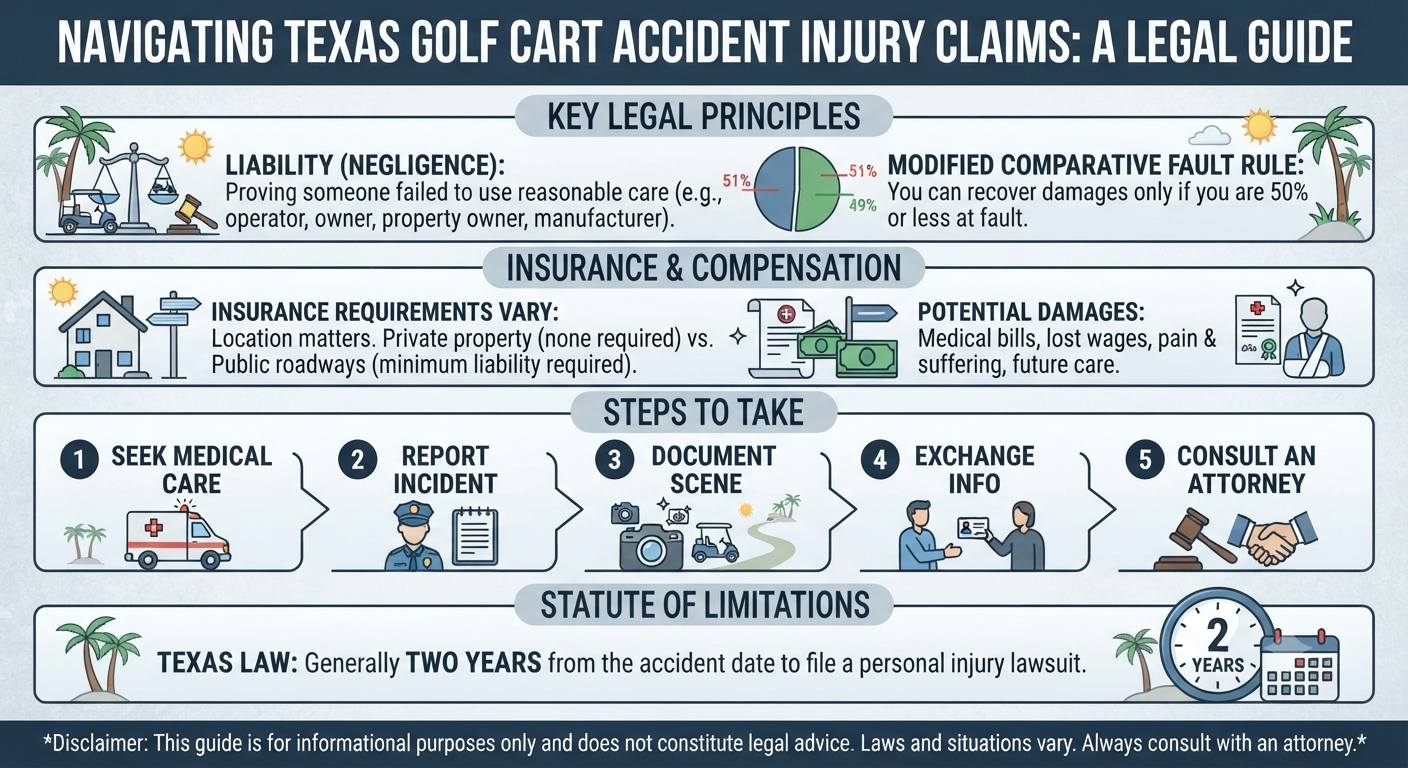
Golf carts have become a common fixture in Texas, frequently seen in master-planned communities, retirement developments, and even on certain public roads. While they offer a convenient way to travel short distances, the casual nature of golf cart use often leads to a false sense of security. Unfortunately, these vehicles lack the robust safety features of traditional automobiles, meaning that when an accident occurs, the resulting injuries can be severe—ranging from minor bruises to life-altering trauma.
If you or a loved one has been injured in a golf cart accident, understanding the complexities of Texas law is vital to protecting your rights and securing the compensation you deserve.
Understanding Liability in Texas
Determining who is responsible for a golf cart accident is rarely straightforward. In Texas, liability generally depends on identifying which party failed to exercise “reasonable care”. Depending on the circumstances of the crash, several parties may be held accountable:
-
Golf Cart Operators: Drivers have a duty to operate their vehicles safely. If an operator was speeding, distracted, intoxicated, or reckless, they may be held liable for the injuries they caused.
-
Golf Cart Owners: Under certain circumstances, owners can be held responsible even if they were not driving. This can occur if they failed to maintain the vehicle or knowingly entrusted it to an inexperienced, reckless, or intoxicated individual.
-
Property Owners: Golf courses, resorts, and apartment complexes have a duty to maintain their premises. If poorly maintained paths, inadequate signage, or other hazardous conditions on their property contributed to the accident, they may be liable.
-
Manufacturers and Repair Shops: If an accident was caused by a mechanical defect—such as faulty brakes, steering issues, or an accelerator malfunction—the manufacturer or the shop that last serviced the cart might be held liable for the resulting harm.
Texas Insurance Requirements
Insurance mandates for golf carts in Texas depend heavily on where and how the vehicle is being operated.
-
Private Property: Texas law does not mandate insurance if the golf cart is operated exclusively on private property.
-
Public Roadways: If your city or county permits the use of golf carts on public streets (typically roads with speed limits of 35 mph or less), state law requires the owner to carry minimum liability coverage. This includes:
-
$30,000 for bodily injury per person.
-
$60,000 for total bodily injury per accident.
-
$25,000 for property damage per accident.
-
-
Low-Speed Vehicles (LSVs): If the vehicle is registered as an LSV rather than a standard golf cart, it must be titled, registered, and insured at all times.
Proving Your Claim: The “Modified Comparative Negligence” Rule
One of the most important aspects of a Texas personal injury claim is the state’s “modified comparative negligence” rule. Texas allows injured parties to recover damages only if they are found to be 50% or less at fault for the accident.
-
The 51% Bar Rule: If a jury or insurance adjuster determines you are 51% or more responsible for the accident, your right to recover any compensation is completely eliminated.
-
Reduction of Damages: If you are found to be partially at fault (e.g., 20%), but under the 51% threshold, your total compensation will be reduced by your percentage of fault.
Insurance adjusters often attempt to shift blame onto the victim to cross this 51% threshold. Having an experienced attorney to counter these narratives and protect your case is essential.
Steps to Take Immediately After an Accident
If you are injured, your actions in the moments following the crash can significantly impact the success of your claim.
-
Call 911: Report the accident immediately. If injuries are severe or damages exceed $1,000, you are legally required to report the crash to law enforcement.
-
Prioritize Safety and Medical Care: Check yourself and others for injuries. Even if you feel “fine,” seek a professional medical evaluation; some injuries, such as concussions or internal trauma, may not be immediately apparent.
-
Gather Evidence: If it is safe to do so, photograph the scene, vehicle damage, and any visible injuries. Exchange insurance and contact information with all involved parties and document contact details for any witnesses.
-
Preserve Records: Keep copies of your medical bills, treatment plans, police reports, and any correspondence related to the accident.
-
Observe the Statute of Limitations: In Texas, you generally have two years from the date of the accident to file a personal injury claim. Failing to meet this deadline can result in your case being dismissed, causing you to forfeit your right to compensation.
References
-
Alber Insurance Agency: Golf Cart Insurance
-
Calderon Law Firm: What Is Comparative Negligence in Texas Personal Injury Cases?
-
Dax F. Garza, P.C.: Texas Comparative Negligence Explained (51% Fault Rule)
-
Evans Law, PLLC: How Long to File a Personal Injury Claim in Texas?
-
Hilliard Law: Texas Golf Cart Accident Lawyers
-
Joe I. Zaid & Associates: Can You Sue After a Golf Cart Accident in Texas?
-
Rollo Insurance: Golf Cart Insurance in Texas
-
Stanley Personal Injury Lawyers: What to Do If You Are Injured in a Golf Cart Accident
-
Texas Constitution and Statutes: Chapter 601, Motor Vehicle Safety Responsibility Act
-
Texas Injury Lawyers Blog: Can You Sue After a Golf Cart Accident in Texas?
