

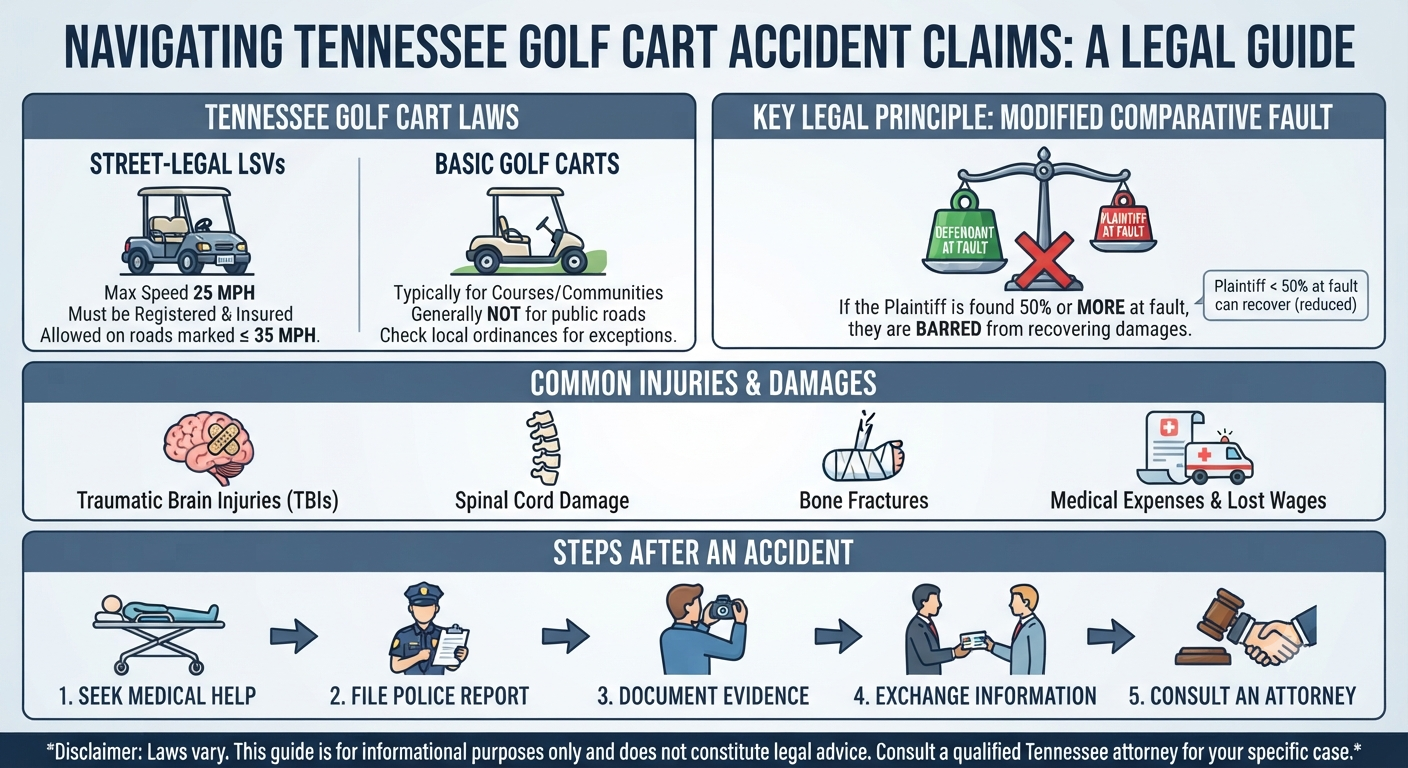
Golf carts are a popular way to enjoy Tennessee’s scenic golf courses, gated communities, and certain local roadways. While they offer a relaxed way to travel, their lack of structural protection—such as seatbelts, airbags, and reinforced frames—means that accidents can result in severe injuries, including traumatic brain injuries, spinal cord damage, and bone fractures.
If you or a loved one has been injured in a golf cart accident, understanding Tennessee’s legal landscape is essential to protecting your right to compensation.
1. Establishing Liability
Liability in a golf cart accident depends on the specific circumstances of the crash. Depending on the evidence, several parties could be held accountable:
-
The Driver: If the operator was reckless—speeding, making sharp turns, or driving under the influence—they may be held liable for resulting injuries.
-
Property Owners or Event Hosts: Owners have a duty to keep their premises free from hazards. If an accident occurs due to poorly maintained paths, hidden obstacles like large branches, or inadequate lighting, the property owner may be negligent.
-
Manufacturers: If the accident was caused by a mechanical defect—such as failing brakes or steering malfunctions—the manufacturer could be held liable in a product liability lawsuit.
-
Employers: Under the doctrine of respondeat superior, an employer may be held responsible for the actions of an employee who causes an accident while acting within the scope of their official duties.
2. Tennessee’s Modified Comparative Negligence Rule
Tennessee uses a modified comparative negligence system, often called the “50% Bar Rule,” which directly impacts your ability to recover damages.
-
The 50% Threshold: If you are found to be 50% or more responsible for the accident, you are completely barred from recovering any compensation.
-
Proportional Recovery: If you are found to be 49% or less at fault, you may still recover damages, though your total award will be reduced by your percentage of responsibility.
-
Example: If your claim is worth $100,000 but you are found 30% at fault, your recovery would be reduced to $70,000.
-
Insurance companies often aggressively attempt to shift blame onto the injured party to reach this 50% threshold and avoid paying the claim entirely.
3. Critical Deadlines: Statute of Limitations
Tennessee has one of the shortest statutes of limitations in the United States for personal injury cases.
-
One-Year Deadline: In most cases, you must file a personal injury lawsuit within one year from the date of the injury.
-
Consequences of Delay: Once this year passes, you generally lose your right to pursue compensation through the court system, regardless of the strength of your case.
-
Limited Exceptions: While exceptions exist—such as for minors, cases involving mental incompetence, or the “discovery rule” for latent injuries—they are uncommon and should not be assumed without professional legal guidance.
4. Steps to Take After an Accident
Your actions following an accident can significantly impact your legal claim:
-
Seek Medical Attention: Prioritize your health; some injuries, such as brain trauma, may not be immediately apparent.
-
Gather Evidence: Collect contact information from witnesses, take photographs of the scene, and document the damage to the cart and your surroundings.
-
Preserve Records: Keep detailed records of all medical bills, reports, and communications with insurance companies.
-
Avoid Recorded Statements: Do not sign documents or provide recorded statements to insurance adjusters before consulting with an attorney, as these can be used to unfairly shift fault onto you.
-
Consult an Attorney: Contact a personal injury lawyer quickly to investigate the scene, preserve physical evidence, and ensure your claim is filed before the one-year deadline.
Reference
-
Tennessee Code Annotated (T.C.A.) § 28-3-104: Statute of limitations for personal injury (1 year).
-
Tennessee Code Annotated (T.C.A.) § 29-11-101 et seq.: Comparative fault principles in Tennessee.
-
Tennessee Department of Safety and Homeland Security: Guidelines for Low-Speed Vehicle (LSV) operation.
-
McIntyre v. Balentine (1992): Tennessee Supreme Court ruling that established the state’s modified comparative fault system.
-
David Randolph Smith & Associates: Understanding Tennessee Statute of Limitations.
-
The Higgins Firm: Golf Cart Accident Liability in Tennessee.
