
In many Florida retirement communities, golf carts are a staple of daily life, offering a convenient way to navigate neighborhoods, golf courses, and social venues. However, their widespread use in environments where they mingle with pedestrians, bicyclists, and traditional motor vehicles carries significant risks. If you are involved in a collision, it is essential to understand how Florida law manages liability, insurance, and the unique legal status of these vehicles.
Understanding Legal Liability
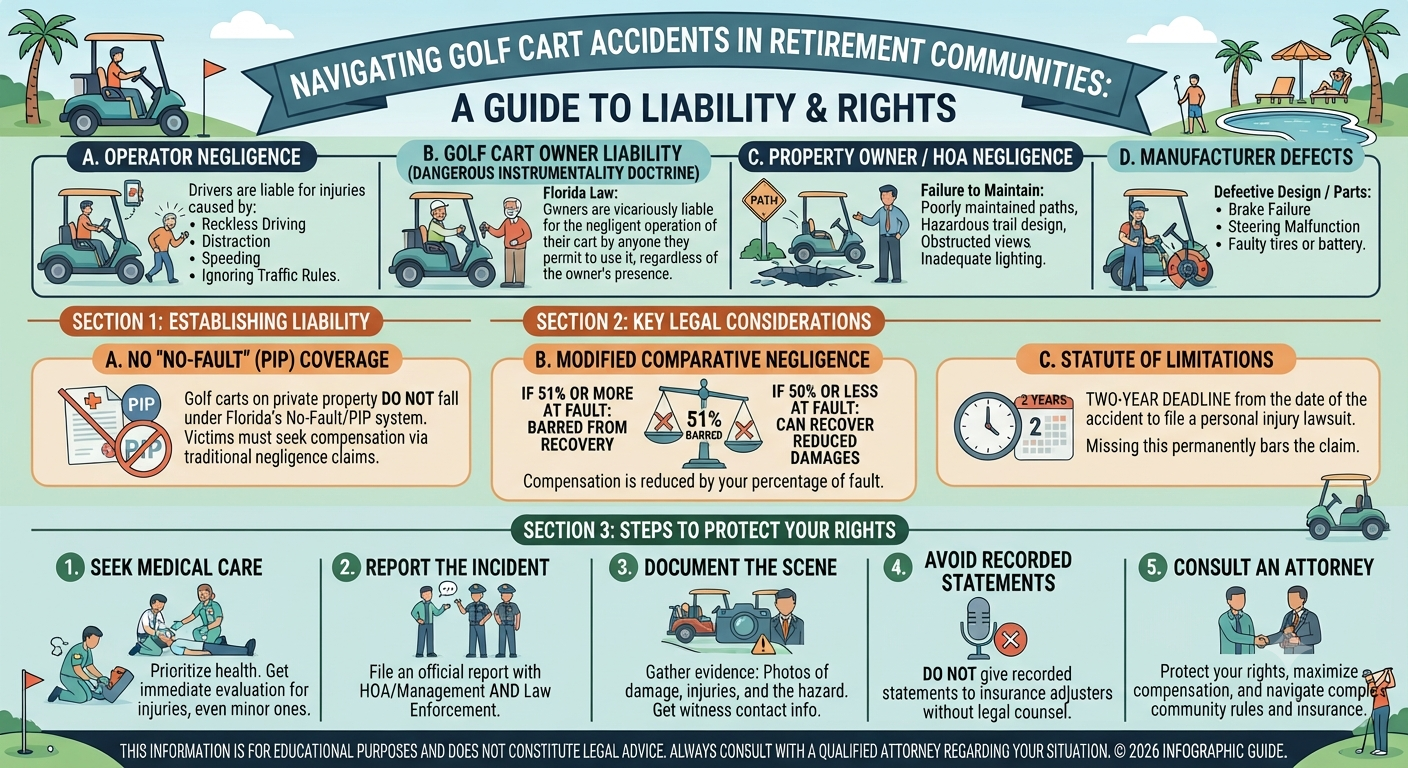
Liability for a golf cart accident is rarely straightforward and often involves multiple parties depending on the circumstances of the crash.
-
The Driver: If an operator is reckless, distracted, or violates traffic laws, they may be held directly liable for injuries caused to others.
-
The Golf Cart Owner: Under Florida’s Dangerous Instrumentality Doctrine, golf carts are classified as “dangerous instrumentalities”. This means an owner can be held vicariously liable for the negligent actions of anyone they permit to operate their cart, even if the owner was not present during the incident.
-
Property Owners and HOAs: Homeowners’ Associations (HOAs) or Property Owners’ Associations (POAs) have a duty to maintain common areas in a reasonably safe condition. They may be held liable if accidents are caused by poor path maintenance, dangerous design, inadequate lighting, or malfunctioning gate sensors.
-
Manufacturers: In instances where an accident is caused by a mechanical failure—such as steering or brake malfunctions—a product liability claim against the manufacturer may be appropriate.
The Reality of Golf Cart DUIs
A dangerous misconception exists that golf carts are exempt from DUI laws due to their size or speed. In reality, Florida law treats golf carts as motor vehicles, and operators are subject to the same strict DUI regulations as any other motorist.
-
Broad Jurisdiction: You can be arrested for a DUI on a golf cart whether you are on a public road, a golf course, a parking lot, or, in certain circumstances, private property.
-
Legal Thresholds: An operator is subject to arrest if their blood or breath alcohol concentration (BAC) is 0.08% or higher, or if their “normal faculties” are impaired.
-
Severe Consequences: Penalties for a golf cart DUI can include significant fines, license revocation, mandatory ignition interlock device installation, and imprisonment. A DUI conviction also serves as powerful evidence of negligence in any related civil claim.
Insurance and Legal Considerations
Navigating compensation after an accident can be complicated by “coverage gaps” and shifting legal standards.
-
Comparative Negligence: Florida follows a modified comparative negligence system. You may recover damages even if you are partially at fault, provided your share of responsibility is 50% or less. If you are found more than 50% at fault, you recover nothing.
-
Statute of Limitations: For accidents occurring on or after March 24, 2023, the deadline to file a negligence-based personal injury lawsuit is two years from the date of the incident. Missing this deadline can permanently bar your right to seek compensation.
-
Insurance Coverage: Florida does not mandate liability insurance for standard golf carts, though it is highly recommended. Standard homeowners’ policies often provide limited protection on the insured’s own premises, but coverage frequently “evaporates” once the cart leaves that property or enters a public road.
Immediate Steps to Protect Your Rights
If you are involved in a collision, the following steps can help preserve your legal interests:
-
Prioritize Medical Care: Obtain a professional medical evaluation immediately, as symptoms for head or spinal injuries can be delayed.
-
Report the Incident: File an official report with property management, the HOA, or law enforcement.
-
Document the Scene: Photograph vehicle damage, your injuries, and any hazardous infrastructure (such as potholes or faulty gates) that contributed to the crash.
-
Exercise Discretion: Avoid discussing the accident details with neighbors or on social media, as insurance investigators may use such statements to undermine your claim.
-
Seek Legal Counsel: Consult with a personal injury attorney experienced in golf cart accidents to identify all available insurance policies and navigate community-specific regulations.
Disclaimer: This information is for educational purposes and does not constitute legal advice. Laws can vary by municipality and specific community covenants; always consult with a qualified personal injury attorney regarding the specifics of your situation.
References
-
KFB Law. Florida Golf Cart Laws.
-
Roman Austin Personal Injury Lawyers. Who’s Liable When a Golf Cart Accident Occurs in a Retirement Community?
-
McPherson & Thomas, PA. Florida Golf Cart Accident Laws: What You Need to Know.
-
Pittman Law Firm, PL. Who Pays When Your Child Causes a Fort Myers Golf Cart Accident?
-
Swoper Dante. Florida Statute of Limitations for Personal Injury (2026 Update).
-
DeLoach, Hofstra & Cavonis, P.A. How long do I have to file a personal injury lawsuit in Florida?
-
DeLoach, Hofstra & Cavonis, P.A. Dangerous Instrumentality Doctrine in Florida.
-
Alper Law. Florida’s Dangerous Instrumentality Doctrine: Vehicle Owner Liability for Car Accidents.
-
Sammis Law Firm. Can you get a DUI on a golf cart in Florida?
-
Bogin, Munns & Munns, P.A. Can I Get a DUI on a Golf Cart?
