
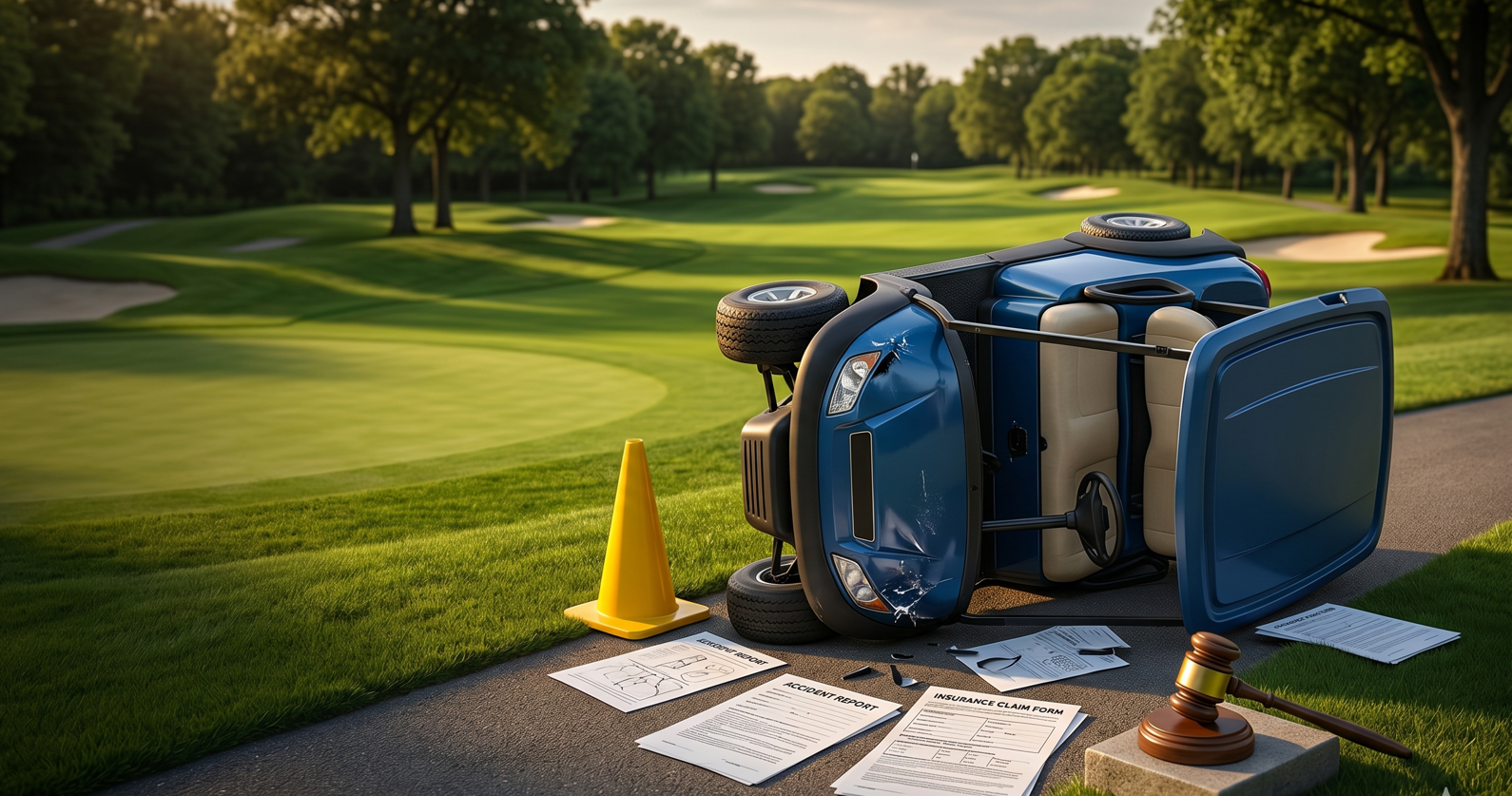
Golf carts aren’t just for the fairways anymore. From bustling retirement communities like The Villages in Florida to beachside resorts and gated neighborhoods, these compact vehicles have become a primary mode of transportation. However, their rise in popularity has been met with a startling statistic: every year, golf cart-related accidents send over 13,000 people to the emergency room.
If you find yourself in the aftermath of a collision, the “easy” answer to who is responsible is often elusive. Determining liability is a complex puzzle involving drivers, property owners, manufacturers, and even local municipalities. This guide breaks down the legalities and logistics of golf cart liability to help you navigate the road to recovery.
1. Determining Liability: The Core Factors
Liability in a golf cart accident is rarely a one-size-fits-all situation. It typically hinges on the concept of negligence, which requires proving that someone failed to exercise reasonable care.
The At-Fault Driver
The most common liable party is the person behind the wheel. A driver may be held responsible if they were:
-
Intoxicated: Studies show that up to 40% of hospitalized golf cart drivers had been drinking.
-
Distracted: Using a phone or focusing on passengers rather than the path.
-
Reckless: Speeding, making sharp turns that lead to rollovers, or failing to engage brakes properly.
-
In violation of local laws: For instance, driving at night without lights or on prohibited secondary roads.
The Golf Course or Country Club
If you lease a cart from a facility, the establishment carries a duty of care to provide safe, well-maintained equipment. The course may be liable if the accident was caused by:
-
Mechanical Failure: Faulty brakes, sticky accelerators, or worn tires due to a lack of preventative maintenance.
-
Unsafe Terrain: Hidden hazards, such as deep potholes or loose gravel on designated paths, can make the property owner responsible under premises liability.
2. Third-Party Liability: Manufacturers and Municipalities
Sometimes, the cause of the crash isn’t the driver or the location, but the cart itself or the road it’s on.
Manufacturers and Designers
If a golf cart has a design or manufacturing defect, such as a faulty steering component or lack of necessary rollover protection, the manufacturer or distributor can be held liable through a product liability claim.
Municipalities and Road Maintenance
If the accident occurred on a public road where golf carts are legally permitted, the local government might be at fault. This occurs when the municipality fails to:
-
Provide adequate signage or traffic signals.
-
Maintain clear lane markings or repair dangerous potholes.
3. The Role of Shared Fault (Comparative Negligence)
Legal systems often recognize that more than one person can be “wrong.” Many states follow comparative negligence rules.
Example: If you are awarded $100,000 but were found 20% at fault for the accident (perhaps for dangling a limb outside the cart), your recovery would be reduced to $80,000.
In “modified” comparative negligence states, you may be barred from collecting anything if your portion of fault exceeds 50%.
4. How Insurance Coverage Works
Unlike cars, golf carts are not always legally required to have insurance, which complicates financial recovery.
-
Homeowners Insurance: Many policies only cover accidents that occur on your own property or a golf course.
-
Specialized Golf Cart Insurance: These policies offer broader protection, including bodily injury liability (for injuries you cause to others) and medical payments coverage (for your own bills, regardless of fault).
-
Uninsured Motorist Coverage: This is vital if you are hit by a driver who has no insurance.
5. Step-by-Step Actions After an Accident
Proving liability requires immediate action. Follow these steps to protect your potential claim:
-
Seek Medical Attention: Records from emergency departments are crucial evidence of your injuries.
-
Document the Scene: Take photos of property damage, skid marks, and the surrounding environment.
-
Identify Witnesses: Collect statements and contact information from anyone who saw the crash.
-
Preserve the Cart: If you suspect mechanical failure, do not let the cart be repaired until an expert can inspect it.
-
Consult a Specialist: Because of strict statutes of limitations (often 2–4 years for injury and 2 years for wrongful death), you must act quickly to preserve your rights.
The Verdict on Liability
Liability in a golf cart accident is a multi-layered issue. Whether it’s a driver’s error, a course’s neglect, or a manufacturer’s defect, identifying the responsible party is the first step toward getting the compensation you deserve for medical bills, lost income, and pain and suffering.
Did you find this guide helpful? Share this article with your community to help keep the pathways safe! If you’ve experienced a golf cart incident, share your thoughts in the comments below.
