

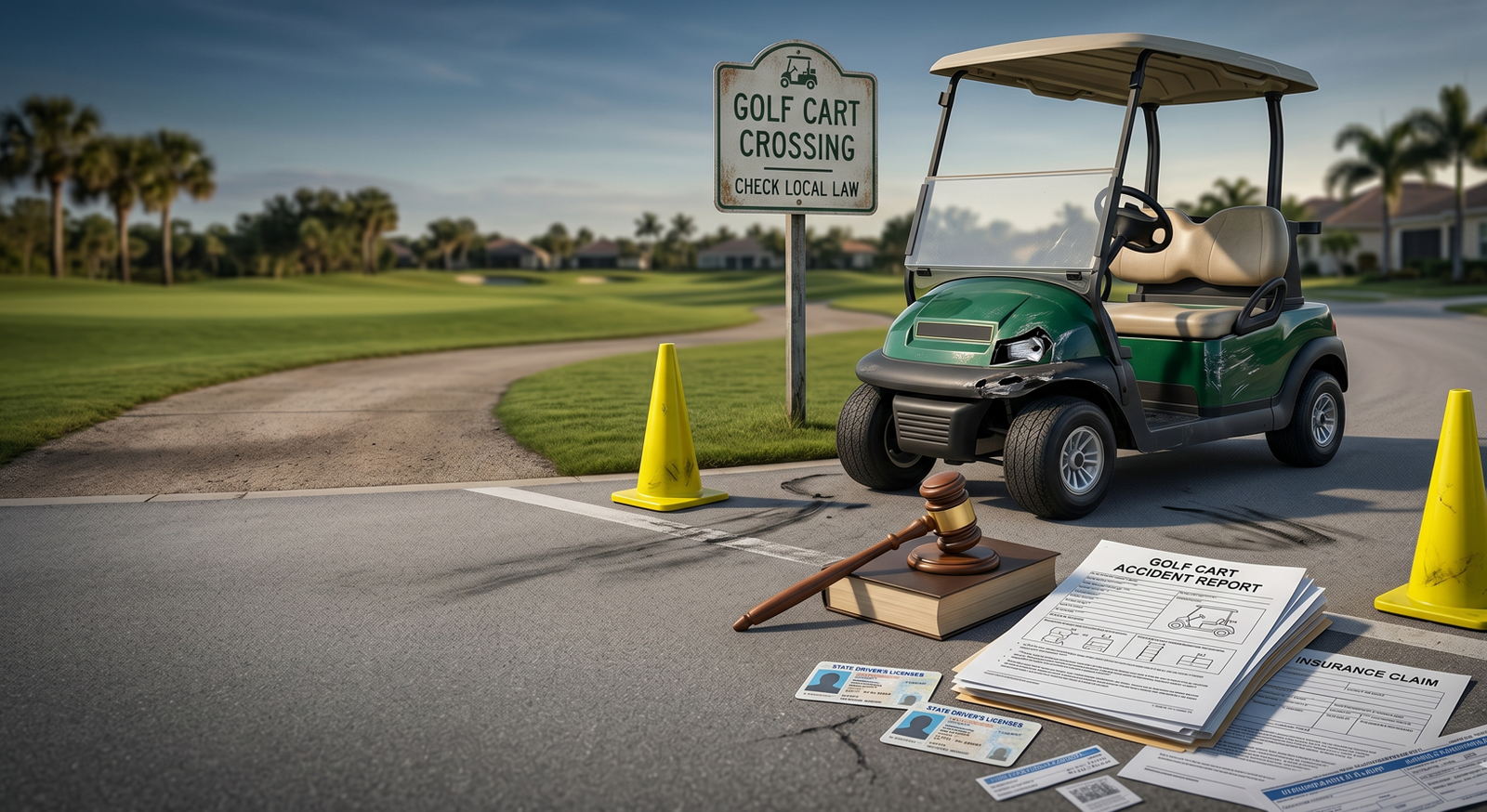
Golf Cart Accident Laws by State and Essential Safety Guide
Golf carts have migrated from the quiet fairways of country clubs to the bustling streets of retirement communities, beach towns, and gated neighborhoods. While they offer a breezy and convenient way to get around, their presence on public roads has created a complex web of legalities. Because these vehicles often lack the safety infrastructure of standard cars, understanding the specific laws in your area is the best way to protect your physical and financial well-being.
Whether you are a seasoned “cart-commuter” or a vacationer renting a ride, this guide breaks down the essential legal landscape of golf cart operations across the United States.
The Legal Distinction Between Golf Carts and LSVs
Before diving into state-specific rules, we must clear up a common point of confusion: the difference between a traditional golf cart and a Low-Speed Vehicle (LSV).
Traditional Golf Carts
Most standard golf carts are designed for speeds under 15 mph and lack advanced safety equipment. Legally, these are often governed by local municipal codes rather than strict state motor vehicle statutes.
Low-Speed Vehicles (LSVs)
An LSV is a “street-legal” cart capable of speeds between 20 and 25 mph. Under federal law, these must have a Vehicle Identification Number (VIN) and specific safety features, including headlamps, turn signals, mirrors, and seat belts.
A Glimpse at Golf Cart Laws by State
State laws vary wildly. Some states are “golf cart friendly,” while others treat them with the same strictness as a full-sized SUV.
Florida: The Golf Cart Capital
Florida has some of the most developed golf cart laws in the country.
-
Driver Age: You do not necessarily need a driver’s license to operate a standard golf cart, but you must be at least 14 years old to drive on designated public roads.
-
Time of Day: Standard carts are generally restricted to daylight hours unless they are equipped with proper lighting.
-
LSV Status: If the cart is an LSV, it must be registered, titled, and insured just like a car.
California: Strict Roadway Access
California takes a more structured approach to “Neighborhood Electric Vehicles” (NEVs).
-
Speed Limits: Carts are typically only allowed on roads with speed limits of 35 mph or lower.
-
Licensing: Drivers must possess a valid driver’s license.
-
DUI Laws: California strictly applies DUI laws to golf cart operators. If you’ve had one too many at the 19th hole, you can face the same penalties as if you were driving a sedan.
Texas: Local Control
Texas law grants significant power to local municipalities.
-
Public Roads: Carts can be driven on public roads with a speed limit of 35 mph or less, but only within 2 miles of a golf course or in a master-planned community.
-
License Plates: While they don’t need traditional registration, carts used on public roads must display a specific “Golf Cart” license plate.
Arizona and South Carolina: Lighting and Liability
-
South Carolina: Requires carts to stay within 4 miles of the owner’s residence and prohibits nighttime driving.
-
Arizona: Requires carts to have liability insurance if they are operated on any public road.
Who Is Liable in a Golf Cart Accident?
Determining liability in a cart crash is often more difficult than a car accident because of the “gray area” of insurance.
The Negligence Standard
Like car accidents, liability usually falls on the party who was negligent. This could include:
-
The Driver: For speeding, driving while distracted, or making sharp turns that lead to a rollover.
-
The Property Owner: If a country club fails to maintain a path, leading to a crash, they may be liable under premises liability.
-
The Manufacturer: If a mechanical failure (like brake failure) caused the crash, a product liability claim may be possible.
The Comparative Negligence Rule
Many states use a “comparative negligence” system. If you were found 20% at fault for not wearing a seat belt, your total compensation for injuries could be reduced by that same 20%.
Common Injuries and Why They Happen
Because golf carts have an open-air design and a high center of gravity, accidents often result in severe trauma.
-
Ejection Injuries: This is the most common fatal event. Without doors or belts, passengers are often thrown onto the pavement.
-
Traumatic Brain Injuries (TBI): Research shows that 80% of neurosurgical injuries in golf cart accidents involve skull fractures.
-
Crush Injuries: Rollovers are frequent during sharp turns. If the cart tips, it can pin a passenger underneath its heavy frame.
Step-by-Step Guide to Driving Legally and Safely
If you want to stay on the right side of the law, follow this safety checklist:
-
Check Local Ordinances: Your city might have stricter rules than your state. Always call the local DMV or police department.
-
Verify Your Insurance: Most homeowners’ policies do not cover golf cart accidents on public roads. You likely need a specialized rider or a separate policy.
-
Upgrade Your Equipment: Even if not required by law, adding seat belts and side mirrors can save your life.
-
Observe the “Rule of Two”: Never carry more passengers than there are seats. Overloading increases the risk of a rollover.
Conclusion: Drive Smart, Stay Safe
Golf cart laws by state are constantly evolving as these vehicles become more popular. While they offer a sense of freedom, they carry significant legal and physical risks. By staying informed about your local regulations and prioritizing safety equipment, you can enjoy the ride without the legal headache.
Did you find this state-by-state breakdown helpful? Share this article with your neighbors or comment below with the specific laws in your town!
Resources and Citations
-
[1] Federal Motor Vehicle Safety Standards for Low-Speed Vehicles (49 CFR 571.500).
-
[2] NHTSA Overview of LSV Equipment Requirements.
-
[3] Florida Highway Safety and Motor Vehicles (FLHSMV) Golf Cart Regulations.
-
[4] State-by-state summary of Neighborhood Electric Vehicle statutes.
-
[5] PMC 2024 Study: Neurosurgical Injuries and Golf Cart Safety.
-
[6] CPSC 2024 Report on Off-Highway Vehicle Stability.
-
[7] Analysis of Ejection-Related Trauma in Non-Traditional Vehicles.
