
Imagine a bright, sunny afternoon. You are cruising down a paved path in a master-planned neighborhood or heading toward the ninth hole at your favorite local country club. The breeze is perfect, your favorite music is playing, and out of nowhere, another cart cuts a sharp corner too fast. There is a terrible screech of plastic, a hard jolt, and suddenly your peaceful day transforms into a blur of flashing ambulance lights, medical forms, and high stress.
As the initial shock fades, reality sets in along with a mountain of unexpected medical bills. It does not take long before you start asking the ultimate financial question: What is the average golf cart accident settlement amount?
The absolute truth is that there is no single, fixed mathematical average for a golf cart accident settlement. Because these unique incidents exist at a strange legal crossroads—combining elements of motor vehicle law, premises liability, and recreational safety guidelines—payouts fluctuate wildly. A minor claim involving some bruising might settle for $10,000, while a catastrophic rollover resulting in fractures or a brain injury can easily surpass $100,000, $400,000, or even exceed $1 million depending on the available insurance coverage.
Instead of hunting for an abstract, arbitrary average number, it is infinitely more helpful to analyze the exact legal mechanics, real-world case precedents, and insurance frameworks that dictate how these claims are valued. Let us pull back the curtain on how insurance adjusters calculate these numbers and see what your case could actually be worth.
The Core Building Blocks of a Injury Claim
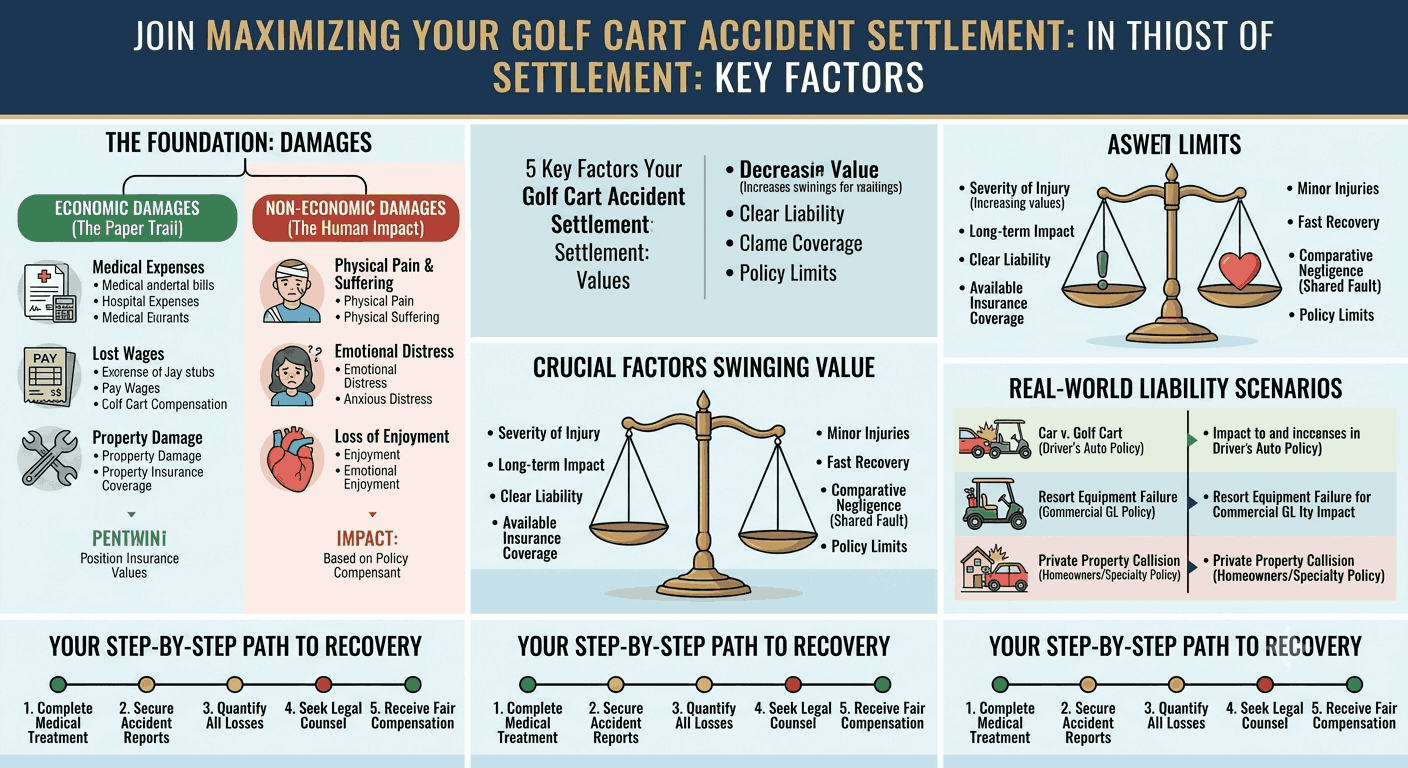
When an insurance company reviews a golf cart injury file, they do not simply guess a settlement number. They look at your life through a magnifying glass, dividing your losses into two distinct categories: economic damages and non-economic damages.
Economic Damages (The Literal Paper Trail)
Economic damages represent the concrete, quantifiable out-of-pocket financial losses caused directly by your accident. These are the easiest items to calculate because they come with explicit receipts, invoices, and payroll stubs:
-
Immediate Medical Treatment: Your initial emergency room visit, ambulance transport fees, X-rays, CT scans, and diagnostic lab work.
-
Ongoing Rehabilitation: Future surgeries, specialized doctor visits, physical therapy sessions, and durable medical equipment like crutches, braces, or wheelchairs.
-
Lost Income and Wages: Every single dollar of income you lost because your injuries kept you out of the office, including any hard-earned paid time off (PTO) or sick leave you were forced to drain.
-
Property Damage Costs: The precise expenses required to fix or replace your personal golf cart, expensive clubs, smartphones, or other electronics destroyed in the wreck.
Non-Economic Damages (The Human Toll)
Non-economic damages compensate you for the intangible, non-monetary impact the crash has had on your daily existence. Because these losses lack a clear price tag, insurance adjusters usually take your total economic damages and multiply them by a variable number (typically between 1.5 and 5) based on how much your lifestyle was disrupted:
-
Physical Pain and Suffering: The literal, daily physical discomfort and agony caused by your injuries and subsequent medical procedures.
-
Emotional Distress and Trauma: Dealing with the sudden onset of driving anxiety, insomnia, or post-traumatic stress following a violent rollover.
-
Loss of Enjoyment of Life: Being physically unable to play golf, pick up your grandchildren, participate in hobbies, or enjoy your regular retirement activities.
-
Permanent Disfigurement: Coping with lifelong surgical scars, limp development, or severe friction burns from asphalt contact.
Pivotal Variables That Can Drastically Alter Your Payout
Why do two people with identical injuries walk away with vastly different settlement packages? The answer lies in three hidden, highly variable moving parts that control the financial boundaries of your personal injury claim.
[Injury Severity] + [Total Insurance Limits] - [Your Fault Percentage] = Total Settlement Value
The Extent and Permanence of Your Injury
If you sustain minor soft-tissue damage, like a sprained wrist or general lower back soreness, your settlement will remain on the lower end of the spectrum because you will likely make a full recovery within a few weeks. However, golf carts completely lack structural safety features like airbags, steel crumple zones, or enclosed metal frames.
When a cart flips or collides with a full-sized passenger car, the human body takes the entire impact. Catastrophic injuries—such as traumatic brain injuries (TBIs), shattered limb bones requiring hardware placement, or spinal cord damage—automatically drive settlement values up to accommodate lifetime medical treatment.
The Available Insurance Policy Limits
An entry-level insurance policy behaves like a strict ceiling. If your legal damages total $150,000 on paper, but the at-fault operator only carries a specialized recreational vehicle policy capped at $25,000, collecting the remaining balance can feel like trying to squeeze water from a stone.
To break past these low policy limits, an experienced lawyer will systematically hunt for alternative, overlapping insurance coverages, such as umbrella policies or corporate liability layers.
Comparative Negligence Rules
Most jurisdictions operate under comparative fault systems. If an adjuster or an insurance investigation reveals that you were 25% responsible for the crash—perhaps because you were speeding down a steep hill or taking a tight turn while holding a drink—your final settlement payout will be slashed by exactly 25%. If your claim is valued at $100,000, you will walk away with $75,000.
Real World Case Results and Settlement Examples
To truly understand how these variables play out under real legal pressure, let us look at five notable, public golf cart accident case resolutions from recent years across the United States.
The $111,000 Texting and Rollover Claim (Missouri)
In O’Fallon, Missouri, a passenger was riding in a golf cart when the operator began driving recklessly while actively texting. The cart lost traction, rolled completely over, and pinned the passenger’s arm beneath the roof frame. The victim sustained a severely fractured humerus that required invasive surgery to install a permanent titanium plate and screws.
Attorneys successfully targeted the driver’s primary auto insurance carrier, arguing that the policy’s language extended to low-speed vehicles. The insurer conceded, paying out the full $100,000 policy limit, combined with an extra $11,000 in medical payments from the course itself.
The $180,000 Runaway Cart Settlement (Massachusetts)
A woman playing a round at the Billerica Country Club in Massachusetts was unexpectedly struck by a completely driverless, runaway golf cart. Another player had carelessly left the cart parked at the top of a steep incline without setting the parking brake properly. The heavy vehicle rolled down the hill, slamming directly into the victim and causing a major shoulder injury that demanded extensive surgery.
Despite the defense arguing that the woman had a pre-existing shoulder condition from a decade prior, her legal team proved the new trauma completely reset her medical progress. They negotiated a $180,000 pre-trial settlement paid directly by the country club’s insurance.
The $200,000 Sudden U-Turn Ejection (Florida)
A 39-year-old passenger was riding on the rear-facing seat of a road-licensed golf cart in Treasure Island, Florida. Without warning, the driver executed an incredibly sharp, aggressive U-turn, ejecting the passenger directly onto the hard asphalt pavement. The victim sustained severe facial lacerations, broken teeth requiring intensive dental surgery, and significant nerve damage in her dominant hand.
The at-fault driver’s insurance initially denied liability, offering a measly $34,000. After intense legal pressure, the insurer surrendered the full $100,000 bodily injury limit, and the victim’s attorney successfully extracted an additional $100,000 from her personal underinsured motorist (UM) policy.
The $400,000 Drunk Driving Battle (Georgia)
Following a crowded outdoor concert in Peachtree City, Georgia, a pedestrian was struck and dragged by an intoxicated golf cart driver. The victim suffered a severely crushed lower leg requiring multiple complex bone surgeries and ran up over $75,000 in immediate medical debt.
The driver’s homeowners insurance company aggressively denied the claim, citing an ambiguous recreational vehicle exclusion clause, and offered a insulting $5,000 “nuisance” settlement. The victim’s attorney refused to back down, took the insurance company to court, won a major ruling at the Court of Appeals, and ultimately forced the carrier to settle for $400,000.
The $1.5 Million T-Bone Crash (California)
In a highly complex case out of California, a student riding on the back of a golf cart on a school campus was violently T-boned by a second golf cart operated by school landscape employees. The student was thrown clear of the vehicle, sustaining compound fractures to both legs, including a shattered right tibia and fibula requiring extensive orthopedic reconstruction.
Because the at-fault operators were working as active agents of an institution, the case bypassed restrictive personal policies and targeted the school district’s massive commercial general liability policy, culminating in a $1,500,000 recovery.
Mapping Out the Complex Liability Landscape
If you get into a traditional car accident, you know exactly who to call: the other driver’s auto insurance provider. With golf carts, finding the right bucket of money is rarely that straightforward. Depending on the venue and the context, your claim may navigate several different insurance policies.
| Accident Venue & Type | Primary Target Insurance Policy | Underlying Strategic Complications |
| Public Roadway Collision | At-Fault Driver’s Auto Liability | Standard auto policies often contain strict “four-wheel motor vehicle” definitions that may exclude low-speed carts unless specialized endorsements exist. |
| Private Country Club / Resort | Commercial General Liability (CGL) | Requires proving the resort failed to maintain the cart paths properly or allowed defective equipment on the trail. |
| Gated Community Crash | Homeowners / Umbrella Insurance | Homeowners policies routinely exclude coverage for accidents occurring off the homeowner’s physical property line. |
The Step-by-Step Strategy to Protect Your Compensation
If you want to protect your financial recovery and secure every dollar you are legally owed after a devastating crash, you must act with absolute precision. Follow this structured roadmap to keep the insurance company from undermining your case.
Step 1: Complete Your Medical Treatment Fully
Never, under any circumstances, agree to settle your injury claim while you are still actively recovering. Wait until your primary care physician or orthopedic specialist declares that you have officially reached Maximum Medical Improvement (MMI). Only when your treatment concludes will you know the true, definitive dollar amount of your lifetime medical expenses.
Step 2: Lock Down Unbiased Incident Reports
Immediately secure a certified copy of the local police report, or demand an official copy of the internal incident report if the crash occurred on a private golf course or vacation resort. These documents lock down the timeline, preserve witness contact details, and prevent the at-fault operator from twisting the facts down the road.
Step 3: Centralize Your Proof of Financial Loss
Create a secure, organized digital and physical folder containing every single piece of evidence related to your financial setbacks. Gather itemized hospital billing statements, explanation of benefits (EOB) sheets, letters from your employer’s payroll department validating your missed work hours, and repair invoices.
Step 4: Consult a Specialized Personal Injury Lawyer
Insurance adjusters love nothing more than calling unrepresented victims within 48 hours of a crash to offer a fast, lowball cash settlement. They know that if you sign their release forms early, you waive your legal right to ask for more money later if you need additional surgeries. Retaining an attorney shields you from these manipulative tactics and forces the insurer to take your claims seriously.
Why Having a Lawyer in Your Corner Is Non-Negotiable
Navigating a golf cart accident claim solo is like trying to play a round of golf with nothing but a rusty putter—you simply lack the tools to get the job done right. Insurance companies employ small armies of adjusters and defense lawyers whose entire job description involves minimizing payouts or denying liability completely.
A dedicated personal injury lawyer understands how to audit insurance policies for ambiguous wording, track down third-party camera footage, and build an unshakeable case that forces the insurance company to pay a premium settlement.
Are you currently fighting an insurance provider over an unfair golf cart accident settlement offer? Are you having trouble getting them to acknowledge your pain and suffering or cover your long-term therapy bills? Let us know your story or ask your questions in the comments below, and share this article across your local neighborhood groups to keep your community safe and informed!
References
-
Abel, R. (2005). General Damages Are Incoherent, Incalculable, Incommensurable, and Inegalitarian (but Otherwise a Great Idea). DePaul Law Review, 55, 253-282.
-
Cudowska, M. (2023). A Compassionate State of Mind: How Michigan Personal Injury Lawyers Think about Non-Monetary Goals and Interests? Studia Iuridica Lublinensia, 32(1), 131-158.
-
Hans, V. P., & Vadino, N. (2007). After the Crash: Citizens’ Perceptions of Connective-Tissue Injury Lawsuits. SSRN Electronic Journal.
-
Wansley, M. (2021). The End of Accidents. UC Davis Law Review, 55(1).
