
Filing an insurance claim after a standard automobile accident is relatively straightforward—police reports are filed, insurance cards are exchanged, and claims adjusters follow a well-trodden legal path.
However, filing a golf cart accident insurance claim can quickly become a maze of administrative delays, finger-pointing, and sudden coverage denials. Because golf carts occupy a unique legal gray area between off-road recreational vehicles and registered motor vehicles, insurance companies look closely for policy exclusions to avoid paying out.
If you have been injured or suffered property damage in a low-speed vehicle (LSV) or golf cart crash, knowing exactly how to handle the claims process is essential to getting your medical bills and repair costs covered. Here is your step-by-step blueprint for navigating the claim process successfully.
Step 1: Secure Immediate Medical Documentation
Your physical health is the absolute priority, but from a legal standpoint, immediate medical evaluation is the foundation of your injury claim.
-
Don’t Tough It Out: Adrenaline frequently masks severe soft-tissue damage, concussions, spinal strains, or internal bleeding caused by golf cart ejections.
-
The Insurance Trap: If you wait several days or weeks to visit a doctor or urgent care center, the insurance company’s claims adjuster will argue that your injuries didn’t happen during the crash, or that they weren’t severe enough to warrant compensation.
Every medical record, diagnostic scan, and prescription receipt established in the hours following the accident serves as irrefutable proof connecting your trauma directly to the incident.
Step 2: Establish an Official Police or Security Report
Never let a negligent driver convince you to settle an accident with a handshake or a personal check. You need an official, third-party log of the event.
-
Public Roads and Neighborhoods: If the crash happened on a public street, residential sidewalk, or municipal path, call local law enforcement to the scene immediately so they can file an official police accident report.
-
Private Property (Resorts, Country Clubs, HOAs): If the accident occurred on a private golf course, vacation resort, or gated community, notify management immediately. Demand that a security officer or supervisor fill out an official Premises Incident Report and request a physical copy before you leave the property.
[Crash Occurs] ──> [Call Police / Report to Management] ──> [Official Incident Report Generated] ──> [Insurers Bound to Facts]
Step 3: Gather Bulletproof Visual Evidence
Insurance claims are won or lost based on hard evidence. Before the vehicles are moved or the scene is cleared, use your smartphone to capture extensive documentation:
-
The Vehicles: Photograph the structural damage to the golf cart, any blown tires, shattered windshields, or broken steering linkages. If a traditional car was involved, photograph the damage to both vehicles to demonstrate the force of impact.
-
The Environment: Capture wide shots of the surrounding geography. Photograph potholes, unmaintained path crumbles, blind corners, missing safety signs, or weather conditions (like wet grass or standing water).
-
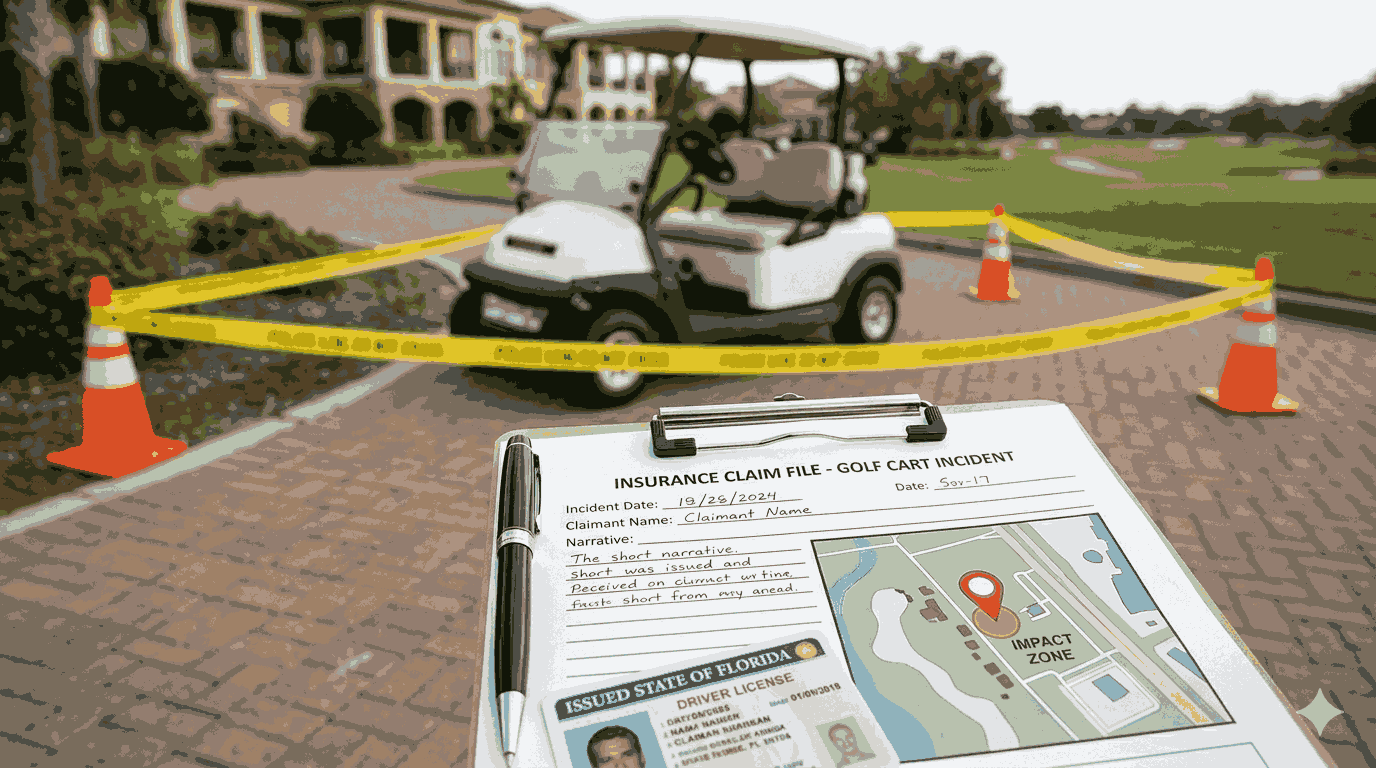
The Scene’s Aftermath: Document skid marks, debris fields, torn turf, and the positioning of any orange traffic cones or investigation tape.
-
Physical Injuries: Take clear photos of your cuts, bruising, casts, or lacerations immediately after the crash and throughout your recovery process.
Step 4: Identify the Correct Insurance Policies
This is where golf cart claims diverge wildly from standard car accidents. Because traditional auto policies routinely exclude golf carts, you must cast a wide net to identify every potential source of coverage:
| Target Policy Route | When It Typically Applies |
| Specialty Golf Cart Policy | Applies if the cart owner purchased a standalone recreational vehicle or off-road policy. This provides the cleanest path to recovery. |
| Commercial General Liability (CGL) | Applies if you were struck by a commercial utility cart driven by an employee (e.g., resort maintenance, golf course staff) or if dangerous property infrastructure caused the crash. |
| Homeowners Insurance | May apply if the crash occurred strictly within the private property lines of the cart owner’s household, though off-premises incidents are widely excluded. |
| Traditional Auto Insurance | Applies if a standard car or truck struck your golf cart, or if the golf cart is a registered, street-legal Low-Speed Vehicle (LSV) carrying its own auto endorsement. |
Step 5: File the Claim and Avoid Initial Adjuster Pitfalls
Once you have identified the appropriate insurance provider, you will open a claim. Shortly after filing, a claims adjuster will contact you. It is vital to remember that the adjuster works for the insurance company, not you. Their primary objective is to settle your claim for the lowest possible dollar amount.
-
Never Give a Recorded Statement: Adjusters are trained to ask open-ended, misleading questions designed to get you to admit fault or downplay your physical pain on a recorded line. Politely decline and state that you will provide a written statement when your medical treatment is complete.
-
Reject the Quick Lowball Offer: Insurers often rush to offer a small, fast payout within weeks of an accident in exchange for you signing a liability release waiver. If you sign this, and later find out you need an expensive surgery, you cannot ask for more money.
1.Step 1: Get Medical Care & Report the Incident:Gather Facts.
Why Legal Representation Is Critical for Golf Cart Claims
Because insurance companies frequently exploit the confusing overlaps between homeowner exclusions and automobile definitions, fighting a claim denial on your own can be exhausting. An experienced personal injury attorney knows how to dissect insurance policy fine print, subpoena company maintenance logs, overcome liability waivers, and ensure your right to full financial recovery is aggressively protected.
Are you currently trying to settle a golf cart property damage or injury claim? Have you run into roadblocks or exclusions with an insurance adjuster? Share your experiences or ask your questions in the comments below, and share this guide to help others protect their rights after an accident!
References
-
Insurance Information Institute (III) (2024). Special claims handling protocols for low-speed and off-road recreational vehicle incidents.
-
Journal of Personal Injury Law (2025). Overcoming standard automobile and homeowner exclusions in non-traditional vehicle injury claims.
-
National Association of Insurance Commissioners (NAIC) Resource Guide (2024). Asset evaluation, liability determinations, and demand package structures for multi-policy insurance disputes.
