
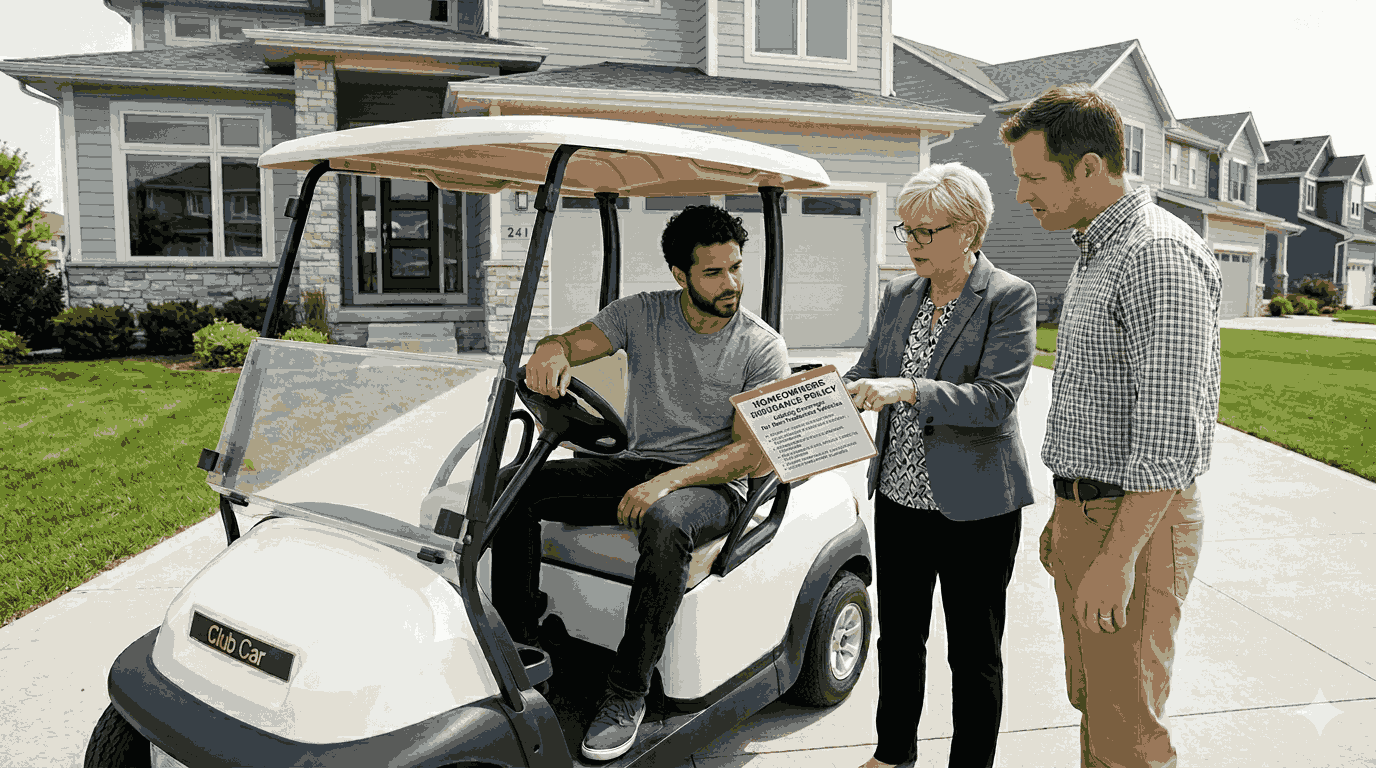
As golf carts become a regular fixture in suburban neighborhoods, retirement villages, and master-planned communities, many owners skip dedicated insurance, assuming a safety net already exists. It’s a common belief: “If it’s my cart and it’s parked at my house, my homeowners insurance will cover it.”
While there is a sliver of truth to that assumption, relying on a standard homeowners policy to cover a golf cart accident is an incredibly risky legal gamble.
Because golf carts don’t fit neatly into traditional property or automobile definitions, homeowners insurance policies handle them with strict, fine-print exclusions. Whether you are a cart owner looking to protect your personal assets or someone injured in a low-speed collision, here is a breakdown of how homeowners insurance actually treats golf cart accidents.
1. The Strict “On-Premises” Rule
A standard homeowners liability policy is designed to protect your assets if someone is injured or property is damaged within the legal boundaries of your insured land. When it comes to golf carts, this geographic limitation is strictly enforced.
-
When It Applies (On-Premises): If your golf cart is parked in your driveway and a guest trips over it, or if you accidentally back the cart into a visitor’s parked car while inside your yard, your homeowners liability and property damage coverage will likely pay for the damages.
-
The Second It Disappears (Off-Premises): The exact millisecond your golf cart tires cross your property line onto a public street, a community sidewalk, a neighbor’s yard, or a local park, your homeowners coverage completely vanishes.
If you strike a pedestrian two doors down or sideswipe a parked car on a public residential road, your homeowners insurance carrier will issue an immediate denial of coverage based on the standard “motorized land vehicle” exclusion.
2. The Gated Community & Golf Course Exception
Some premium homeowners policies feature a special endorsement or clause that slightly expands coverage beyond your personal property lines. However, these exceptions are highly specific:
[Homeowners Policy] ──> [Does it have a Recreational Vehicle Endorsement?]
                             ├── NO ──> Covered ONLY on your private lawn.
                             └── YES ─> Covered on golf courses & designated HOA paths.
In these specialized policies, the insurer may extend liability coverage if the golf cart is being operated on:
-
A designated golf course for golfing purposes.
-
Marked, legal crossing paths within a private, gated homeowners association (HOA) that explicitly permits golf carts.
Even with this exception, the policy will never cover you if you are driving the cart to a nearby grocery store, taking a joyride down a public municipal road, or allowing an unlicensed minor to operate the vehicle.
3. The Structural Gaps: What Homeowners Insurance Never Covers
Even if an accident happens directly on your private property, a homeowners policy fails to provide the comprehensive protection most owners assume they have.
No First-Party Physical Damage (Collision)
If you lose control of your golf cart on your own lawn and crash it into a brick retaining wall, your homeowners insurance will not pay a single dime to fix or replace the golf cart itself. Homeowners insurance treats the cart as a motorized vehicle, which is routinely excluded from personal property coverage.
No Medical Payments for You or Your Family
If your child rolls the golf cart over on your property and suffers a broken arm, your homeowners policy’s medical payments coverage will not apply. Homeowners medical coverage is strictly meant for guests injured on your land, never the residents or operators themselves.
4. Closing the Liability Gap: Specialty Cart Policies
To avoid catastrophic out-of-pocket expenses from an off-premises crash, owners should invest in a standalone Recreational Vehicle or Golf Cart Insurance Policy. These policies operate exactly like auto insurance and follow the vehicle wherever it drives.
| Policy Feature | Homeowners Insurance | Standalone Golf Cart Policy |
| Coverage Area | Strictly on your private property | Public roads, golf courses, and paths |
| Pedestrian Injuries | Denied if off-premises | Fully covered via Bodily Injury Liability |
| Damage to the Cart | Not covered (Excluded asset) | Covered via Collision & Comprehensive |
| Theft or Vandalism | Rarely covered | Fully covered under Comprehensive |
Strategic Steps After a Golf Cart Accident
If you are injured by a golf cart—or if you are an owner facing a potential claim—acting quickly to document the event is crucial to determining which insurance policy is legally on the hook.
1.Prioritize Immediate Medical Evaluation:Establish Medical Records.
Protect Your Rights and Assets
Insurance adjusters are experts at exploiting the legal gray areas of golf cart classifications to deny claims. Because every state, municipality, and HOA has vastly different rules regarding where these low-speed vehicles can legally drive, finding a path to compensation can be incredibly complex. Consulting an experienced personal injury attorney ensures that hidden policy endorsements are uncovered, your assets are protected, and your medical recovery is fully funded.
Do you drive your golf cart outside your neighborhood or stick strictly to your own property? Have you checked your homeowners policy declarations page for a motorized vehicle exclusion? Let us know your thoughts or safety tips in the comments below, and share this article to keep your community informed!
References
-
Insurance Information Institute (III) (2024). Understanding homeowners insurance liability limitations and motorized vehicle exclusions.
-
National Association of Insurance Commissioners (NAIC) (2025). Gaps in coverage: The rising legal exposures of neighborhood golf cart and low-speed vehicle utilization.
-
State Farm Powersports Insurance Analysis (2024). Off-premises vs. on-premises recreational vehicle risk assessment and specialty policy structures.
