

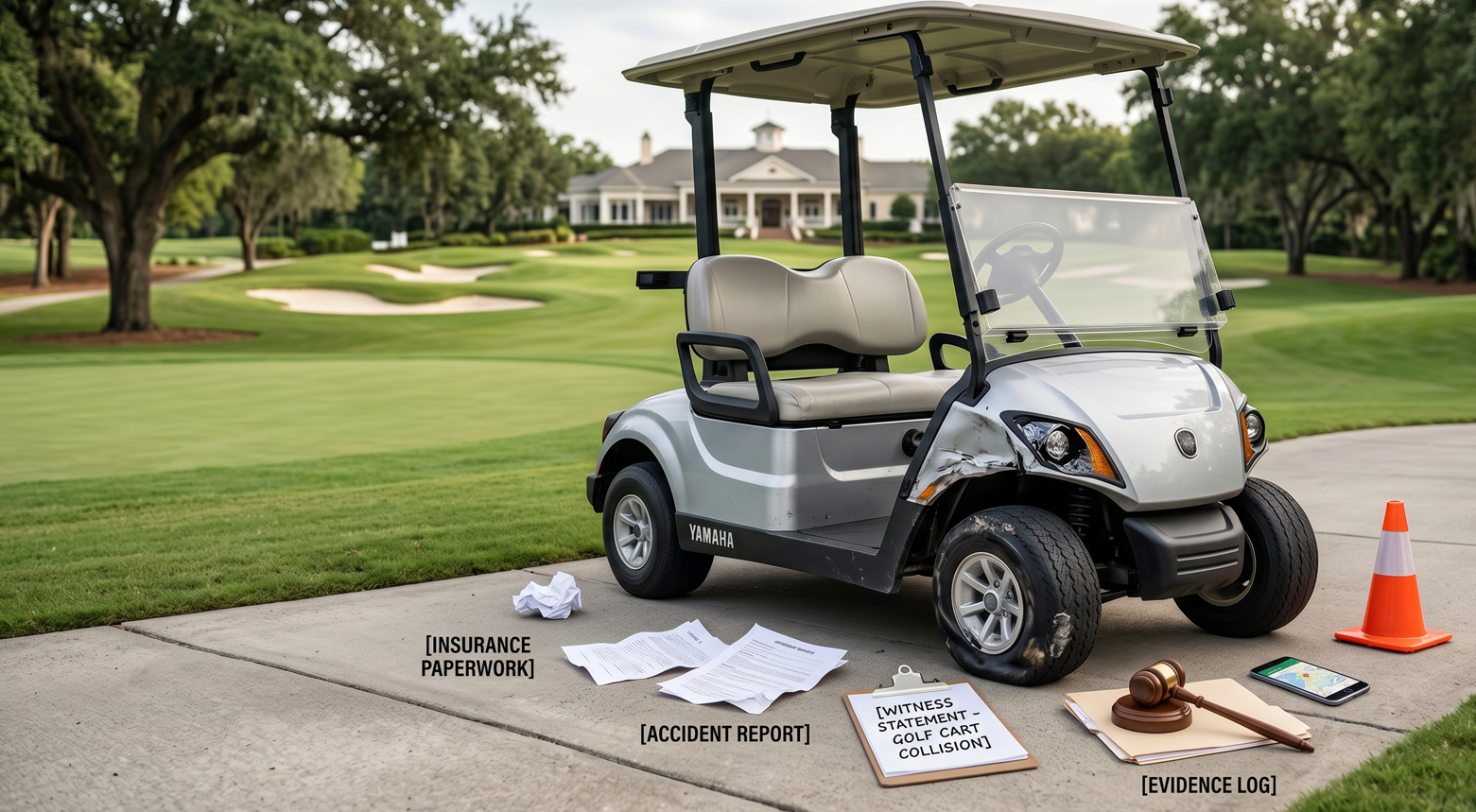
Ultimate Checklist of Evidence Needed for a Golf Cart Accident Claim
Golf carts are no longer confined to the smooth paths of the local country club. Today, they are a primary mode of transportation in beach resorts, gated subdivisions, and massive retirement communities like The Villages. Unfortunately, as golf cart traffic increases, so do collisions.
When a fun ride turns into a serious crash, the physical and financial consequences can be overwhelming. If you plan to seek compensation for your medical bills, lost wages, or pain and suffering, you cannot rely on a simple “he said, she said” argument. You need bulletproof proof.
Building a rock-solid case requires understanding the specific evidence needed for a golf cart accident claim. Let’s break down exactly what you need to collect to protect your rights and maximize your recovery.
Proving Liability in a Golf Cart Case
Before diving into the paperwork, it is helpful to look at the underlying logic of a personal injury case. To secure a payout from an insurance provider or a court, your claim must establish traditional negligence principles. This requires proving four core elements:
-
Duty of Care: The other party had a legal obligation to operate the golf cart safely or maintain a safe environment.
-
Breach of Duty: They failed to meet that standard (e.g., driving while distracted, speeding, or neglecting vehicle maintenance).
-
Causation: This specific failure directly triggered the crash.
-
Damages: You sustained verifiable physical injuries or financial losses as a direct result.
Because golf carts rarely carry Personal Injury Protection (PIP) insurance, proving fault is almost always mandatory to recover compensation.
Scene and Physical Evidence
The moments immediately following an accident are chaotic, but the data you gather at the scene forms the bedrock of your claim. Physical proof is incredibly difficult for insurance adjusters to dispute.
Comprehensive Photographic Evidence
Take your smartphone and document the scene from multiple angles. Do not just take close-ups; pull back to capture the entire environment. Be sure to photograph:
-
The Vehicles: Capture the exact points of impact, shattered windshields, dented panels, or flat tires.
-
The Surroundings: Photograph skid marks, scattered debris, damaged guardrails, or obscured traffic signs.
-
Road Conditions: Document uneven pathways, sudden drop-offs, potholes, or wet, muddy surfaces that may have contributed to a rollover.
-
Your Injuries: Take clear pictures of visible cuts, bruising, lacerations, or casts right at the scene and during your recovery.
Official Accident and Incident Reports
If the crash occurs on a public road, call 911 immediately so law enforcement can file an official police report. This independent, third-party document logs critical details, citations issued, and initial assessments of fault.
If the accident happens on private property such as a resort, golf course, or gated community notify the property management or security team right away. Request a written copy of their internal incident report for your files.
Medical and Financial Proof
You cannot claim compensation for an injury if you cannot prove it exists, how severe it is, and exactly what it is costing you.
Medical Records as Your Primary Proof
Seek medical evaluation immediately after a crash, even if you feel fine. Adrenaline frequently masks serious underlying trauma like concussions or internal bleeding. Your medical paper trail should feature:
-
Emergency room or urgent care discharge summaries.
-
Imaging results, including X-rays, MRIs, and CT scans.
-
Detailed doctor notes, specialist diagnoses, and prescribed physical therapy plans.
-
Itemized medical bills tracking every dollar spent on treatment and prescriptions.
Documenting Lost Income
If your injuries force you to miss work, you are entitled to pursue compensation for those lost wages. To prove these financial losses, compile:
-
Recent pay stubs and tax returns to establish your baseline income.
-
A formal letter from your employer’s HR department verifying your missed time and missed pay.
-
Explicit doctor notes detailing your physical work restrictions.
Witness Testimony and Digital Records
Independent accounts and digital footprints are highly effective tools for cutting through conflicting driver stories.
     [ THE EVIDENCE CHAIN ]
  Scene Photos ---> Witness Accounts ---> Medical Trail ---> Expert Analysis
Eyewitness Statements
Look for anyone who saw the event occur—pedestrians, golfers on nearby greens, or other motorists. Collect their full names, phone numbers, and email addresses. An objective, third-party account stating that the other driver was texting or speeding can instantly break a negotiation deadlock.
Surveillance and Dashcam Footage
Video footage is the holy grail of accident evidence. Check if nearby homes have doorbell cameras, or if a resort path is monitored by security cameras. If another vehicle involved had a dashcam, that footage must be preserved before it is overwritten. Because private owners are rarely eager to hand over video, a lawyer can issue a formal letter to legally preserve this data.
The Value of Expert Witnesses
In complex claims, standard documentation might not be enough to satisfy a stubborn insurance adjuster. That is where professional expert testimony comes into play.
-
Accident Reconstructionists: These specialists analyze vehicle damage, pavement markings, and physics to mathematically recreate the crash and definitively point out who caused it.
-
Medical Experts: They can testify regarding the long-term impacts of your injuries, proving that you will require ongoing care, future surgeries, or permanent physical rehabilitation.
-
Vocational Specialists: If your injuries prevent you from returning to your line of work, these professionals calculate your total loss of future earning capacity.
Crucial Tips for Protecting Your Evidence
Gathering evidence is only half the battle; you also must avoid inadvertently damaging your own case.
-
Keep a Pain Journal: Document your daily pain levels, physical limitations, and the emotional toll of your recovery. This provides tangible, chronological context for “pain and suffering” damages.
-
Never Admit Fault: Avoid saying things like “I’m sorry” or “I didn’t see them either” at the scene. Insurance companies will manipulate these polite phrases to reduce your payout.
-
Stay Off Social Media: Never post updates or photos about your accident or physical activities while your claim is active. Adjusters look for any excuse to claim your injuries are exaggerated.
FAQs About Golf Cart Accident Evidence
What if the accident occurred on private property?
The process remains largely identical. While local police might not issue a standard traffic citation on private property, you still need to secure an incident report from the property management, photograph the scene, and collect witness contacts.
Can a golf cart manufacturer be held liable?
Yes. If a mechanical failure like a brake malfunction or a steering defect caused the crash, product liability laws apply. In these cases, checking the Consumer Product Safety Commission (CPSC) for recent vehicle recalls is an essential step.
How long do I have to gather evidence and file a claim?
This depends on your state’s statute of limitations, which typically gives you a window of two to four years from the date of the accident. However, physical evidence disappears quickly, and witness memories fade, making it critical to act immediately.
Are you currently dealing with the fallout of a golf cart collision? Comment below with your experiences or questions about dealing with insurance adjusters, or share this article with someone trying to navigate their recovery
