
When we think of workplace vehicle accidents, our minds immediately go to commercial trucking accidents, delivery van collisions, or forklift mishaps in warehouses. However, many industries rely heavily on golf carts and low-speed utility vehicles (LSVs) for daily operations. From sprawling golf resorts, country clubs, and hotels to universities, retirement villages, corporate campuses, and construction sites, these open-air vehicles are staple workhorses.
But what happens when an employee crashes a company golf cart, rolls it over, or strikes a pedestrian while on the clock?
The legal fallout quickly shifts from a simple workplace incident to a complex injury claim. Under personal injury and employment law, an injured party can frequently sue the employer for damages. Let’s break down the legal doctrines that establish employer liability in a golf cart accident.
1. Vicarious Liability and Respondeat Superior
The primary legal doctrine used to hold a company responsible for an employee’s golf cart accident is vicarious liability, driven by the Latin principle respondeat superior (“let the master answer”).
Under this doctrine, an employer is automatically held financially liable for the negligent actions of their employees, provided the worker was acting within the scope of their employment at the exact time of the crash.
To prove that a golf cart accident falls under the scope of employment, a plaintiff’s legal team must demonstrate that:
-
The employee was performing an authorized task or duty assigned by the company.
-
The accident occurred during regular, expected working hours.
-
The employee’s use of the golf cart was directly or indirectly benefiting the employer’s business.
The Detour vs. Frolic Distinction
Insurance defense lawyers representing corporations will fiercely look for ways to argue that the employee was acting outside their duties. The legal system evaluates this using two terms:
-
A Detour (Employer Liable): A minor, predictable deviation from work duties. For example, if a resort maintenance worker drives a golf cart to another section of the property to fix a pipe but takes a slightly longer scenic route to grab a quick bottle of water, the employer remains liable if a crash occurs.
-
A Frolic (Employer Not Liable): A major, completely unauthorized abandonment of work duties for purely personal reasons. If an off-duty golf course beverage cart worker takes a cart without permission to joyride or race a friend on a different part of the course, the employer can argue they are completely shielded from vicarious liability.
2. Direct Corporate Negligence: Beyond Vicarious Liability
Even if an employee’s actions don’t cleanly fall under the scope of employment, a company can still face a direct lawsuit for its own independent corporate negligence. These claims focus on the employer’s systemic failure to manage its staff and equipment safely.
Negligent Entrustment and Hiring
Companies have a strict duty to ensure that the employees they put behind the wheel are qualified to drive. An employer faces a devastating direct negligence claim if they hand the keys of a utility cart to a worker and it is later uncovered that:
-
The employee had a well-documented history of reckless driving, multiple DUIs, or a suspended driver’s license.
-
The company failed to run a basic background check or motor vehicle record (MVR) screening prior to hiring.
-
The employee was obviously under the age of local municipal compliance requirements or lacked the physical capacity to safely operate the machinery.
[Inadequate Background Check] ──> [Hiring Driver with Prior DUIs] ──> [On-the-Clock Intoxicated Crash] ──> [Company Sued for Negligent Hiring]
Negligent Training and Supervision
Operating a commercial utility golf cart requires unique safety protocols, especially when navigating terrain crowded with pedestrians, guests, or narrow cart paths. Employers must actively train workers on weight distribution limits, braking distances, and safe incline speeds. Failing to establish written safety rules, letting workers ignore seating capacities, or looking the other way when employees drive distracted constitutes a direct failure to supervise.
Negligent Fleet Maintenance
If a golf cart’s mechanical failure triggers an accident, the employer is directly liable as the property and equipment owner. Because utility carts endure grueling daily wear and tear, businesses must maintain strict, timestamped maintenance logs. A company is exposed to immense liability if a crash is traced back to:
-
Worn Hydraulic Brake Systems: Ignoring squealing or slipping brakes until they fail entirely on a steep slope.
-
Bald or Mismatched Tires: Failing to replace smooth tires, causing a multi-passenger cart to slide violently on wet morning turf.
-
Faulty Steering Assemblies: Neglecting known slack or stiffness in the steering columns of older fleet models.
The Insurance Landscape: Who Pays the Claim?
When an individual or guest is injured by a company vehicle, traditional auto insurance policies rarely provide coverage. Instead, compensation is pursued through specialized commercial insurance lines:
| Insurance Policy Type | Coverage Application in Golf Cart Accidents |
| Commercial General Liability (CGL) | The primary policy that covers bodily injury and property damage inflicted on third parties (guests, pedestrians, other motorists) due to company negligence or employee actions. |
| Commercial Auto Insurance | Applies if the business utilizes street-legal Low-Speed Vehicles (LSVs) that are registered with the DMV and operated on public roads adjacent to the business. |
| Workers’ Compensation | If an employee is a passenger in a cart driven negligently by a co-worker and is injured on the job, their recourse is usually limited to the company’s Workers’ Comp policy, which covers medical expenses and a portion of lost wages regardless of fault. |
Strategic Steps for Victims Following a Commercial Cart Crash
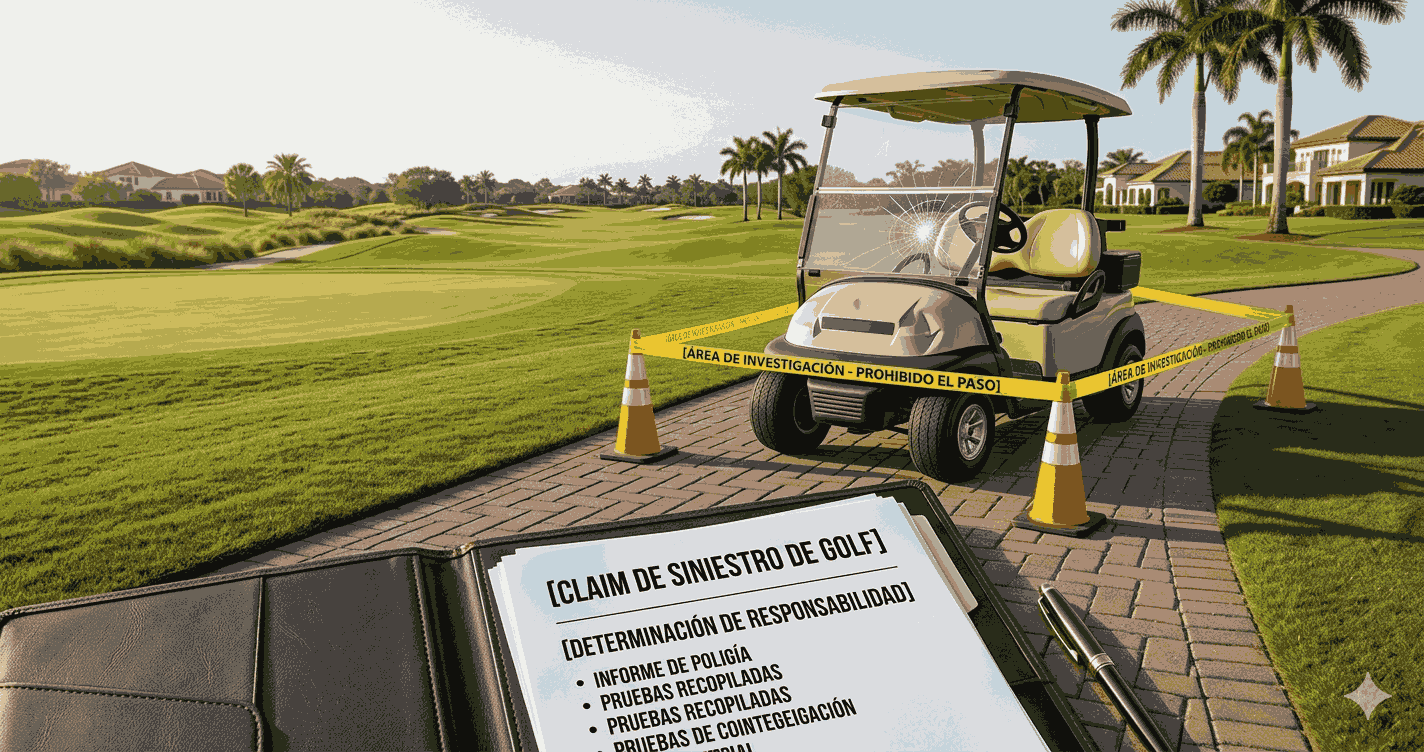
If you are a guest, pedestrian, or worker injured by a commercial or corporate golf cart, you must act meticulously to preserve evidence before a company’s legal department can intervene.
Shielding Corporate Liability: The Role of Comparative Fault
Corporate defense teams will use every strategy available to shift the blame onto the injured party. Under the legal principle of comparative negligence, any financial recovery you win will be reduced by your own percentage of fault.
If the defense proves that you stepped directly out in front of a moving maintenance cart while looking at your phone, or that you were riding on the back of a utility bed against company policy, a court may assign you partial blame. Working with a dedicated personal injury attorney ensures that corporate accountability is strictly maintained and that your right to full compensation is aggressively protected.
Does your workplace utilize golf carts or utility vehicles for daily tasks? Does your company enforce strict safety training and maintenance checks for these low-speed fleets? Share your workplace safety experiences or questions in the comments below, and share this article to keep your network informed about corporate liability!
References
-
American Jurisprudence in Employment Law (2024). Analysis of the doctrine of respondeat superior and scope of employment parameters for non-standard commercial vehicles.
-
Journal of Legal Aspects of Sport and Recreation (2023). Corporate fleet liability, negligent entrustment standards, and commercial maintenance logging compliance.
-
Restatement (Third) of Agency (2025 update). Vicarious liability metrics, detour vs. frolic classifications, and direct corporate negligence frameworks in premises environments.
