
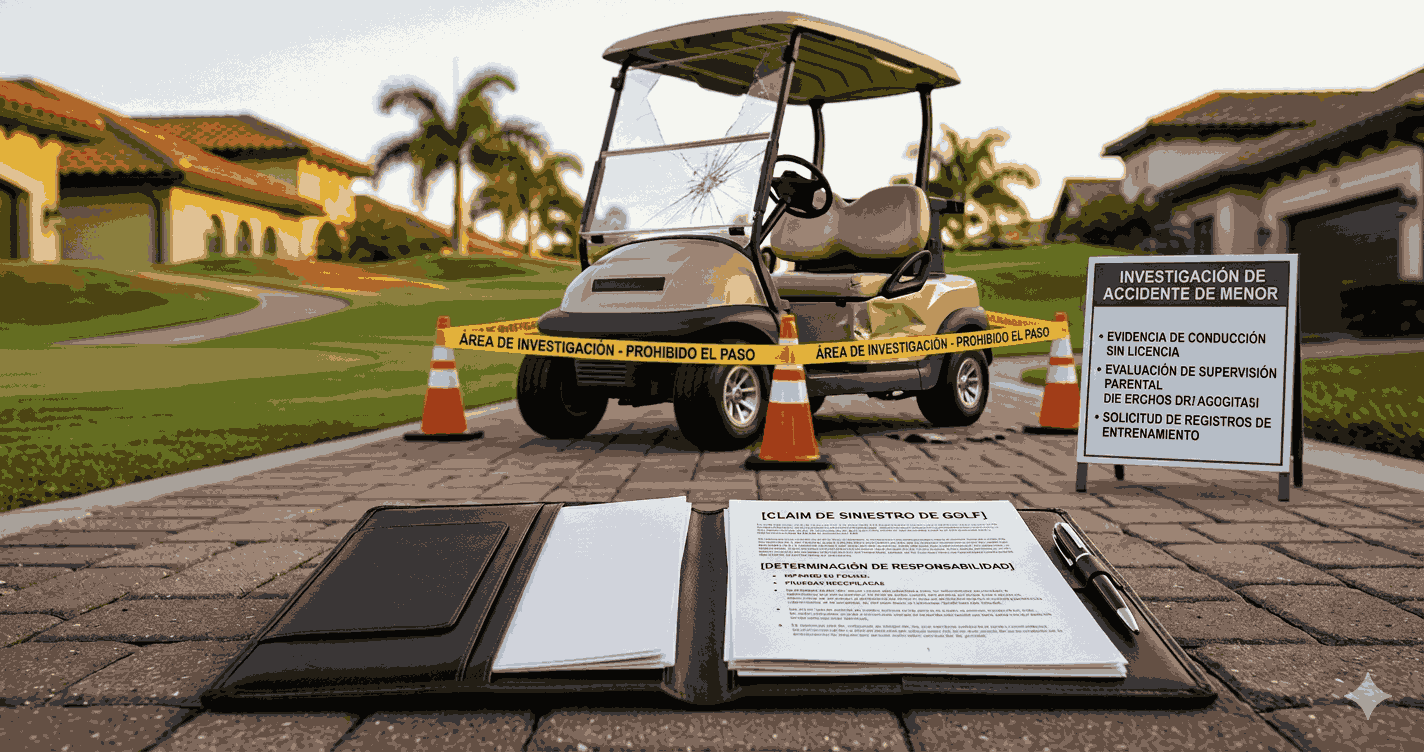
For many families living in resort communities, gated subdivisions, or country clubs, letting a teenager or child take the wheel of a golf cart feels like a harmless rite of passage. Because these vehicles are associated with leisure and recreation, parents frequently overlook a critical reality: golf carts are motorized vehicles capable of causing life-altering injuries.
When an underage, unlicensed driver causes a crash, a rollover, or strikes a pedestrian, the vacation vibe evaporates into an immediate legal nightmare.
If your child was hurt by a reckless young operator, or if you are a property owner facing a potential lawsuit, understanding how the legal system assigns civil liability for an underage golf cart accident is vital. Let’s break down who is financially responsible when an underage driver causes a serious accident.
The Core Concept: Vicarious Liability and Parental Responsibility
Under standard personal injury law, a driver is directly responsible for their own negligent actions. However, minor children typically lack financial assets, income, or independent insurance policies to cover thousands of dollars in medical bills.
To secure compensation for an injured victim, the legal system looks to the adults in charge under a framework known as vicarious liability. In underage golf cart crashes, parents or legal guardians are usually held financially responsible through two main legal doctrines:
1. Negligent Entrustment
This is the most common ground for a lawsuit against a parent. Negligent entrustment occurs when an adult knowingly permits a minor to operate a dangerous piece of machinery (like a golf cart) when they know—or should know—that the child lacks the age, judgment, training, or physical capability to handle it safely.
If a parent hands the keys to a 13-year-old to go to the neighborhood pool, and that child flips the cart while speeding around a corner, the parent can be sued directly for their own poor judgment in supplying the vehicle.
2. The Family Purpose Doctrine
In several jurisdictions, courts apply the “Family Purpose Doctrine” to low-speed vehicles. This rule dictates that if a head of a household purchases and maintains a vehicle for the general pleasure, convenience, and use of their family members, the owner faces liability for any negligent injuries caused by a family member operating that vehicle with implied or express permission.
[Parent Hands Keys to Minor] ──> [Minor Speeds/Loses Control] ──> [Severe Pedestrian Injury] ──> [Parent Sued for Negligent Entrustment]
3 Critical Factors That Determine Liability
An underage golf cart accident claim is rarely simple. Insurance adjusters and courts will analyze specific situational variables to establish fault and assign financial damages.
1. Local State Laws and Municipal Vehicle Codes
The legal age to drive a golf cart varies dramatically by state and county.
-
Some states allow minors as young as 14 to operate a golf cart on designated public paths without a driver’s license.
-
Other municipalities strictly mandate that a golf cart operator must be at least 16 years old or possess a valid learner’s permit.
If a parent allows an underage child to drive in a town where doing so violates local traffic codes, that violation can be used as automatic evidence of negligence (known as negligence per se).
2. Express vs. Permissible Use (Joyriding)
Insurance defense attorneys frequently attempt to shield parents by claiming the minor took the golf cart without parental permission (joyriding). If a teenager sneaks into a neighbor’s garage or takes the family cart without consent, the parents may argue they aren’t liable because they didn’t authorize the ride.
However, if the keys were left completely accessible, or if the parent routinely allowed the child to drive the cart in the past, a court may rule that the child had “implied permission,” keeping the parents on the hook for damages.
3. Negligence of the Property Owner or Resort
Sometimes, liability extends beyond the parents to the commercial facility itself. If a luxury resort or vacation rental company rents a high-powered utility cart to a family without verifying the driver’s age, or fails to enforce their own posted safety regulations regarding minor drivers on their pathways, the business entity can be sued as a co-defendant for premises liability.
The Insurance Battle: Who Pays the Medical Bills?
Finding the right insurance policy to cover an underage driver claim can be incredibly complex. Because golf carts occupy a legal gray area between toys and automobiles, insurance companies routinely try to deny coverage.
-
Homeowners Insurance Policies: This is usually the first line of defense if the crash happens within a private community or on the family’s property. Many standard homeowners policies include personal liability limits that cover accidents involving low-speed recreational vehicles. However, if the policy contains an explicit “underage driver exclusion” or an “off-premises exclusion,” the claim may be denied.
-
Specialized Golf Cart Insurance: If the owner purchased a standalone golf cart policy, it functions similarly to standard auto insurance. These policies generally provide robust bodily injury liability limits to cover a victim’s medical bills, rehabilitation, and pain and suffering, though they still require proof that the operator had permission to drive.
-
Umbrella Policies: In catastrophic cases involving severe fractures, traumatic brain injuries (TBIs), or permanent disability, a family’s standard policy may run out of money. An excess liability or umbrella policy can step in to provide secondary coverage up to millions of dollars.
Steps to Take Immediately Following an Underage Cart Accident
If you or your child has been struck or injured by a minor operating a golf cart, the actions you take at the scene are critical to securing a fair legal recovery.
1.Establish Parental Ownership Immediately:Identify the Adults Accountable.
The Role of Comparative Fault in Minor Claims
Be aware that insurance companies will aggressively look for ways to blame the victim. Under the legal rule of comparative negligence, your final financial payout can be reduced if your own actions contributed to the accident.
For instance, if a teenager takes a sharp turn too fast and you fall out of the passenger seat, the defense may argue you are partially at fault if you were standing up, holding a phone, or roughhousing with the driver. If a jury finds you 25% responsible, your final $100,000 verdict will be legally adjusted to $75,000. Operating as a responsible passenger ensures your physical safety and protects your legal claim from aggressive defense tactics.
Have you ever witnessed young, unlicensed children driving golf carts recklessly in your neighborhood or at a local vacation resort? How does your community handle underage golf cart safety? Share your thoughts and stories in the comments below, and share this article to keep your loved ones informed!
References
-
Journal of Safety Research (2024). Pediatric and adolescent injury trends associated with low-speed utility vehicle rollovers in residential areas.
-
American Jurisprudence in Torts (2023). Parental liability and the doctrine of negligent entrustment regarding minors and recreational motorized vehicles.
-
Restatement (Third) of Torts: Liability for Physical and Emotional Harm (2025). Evaluating vicarious liability and implied permission frameworks in non-automotive vehicular claims.
