
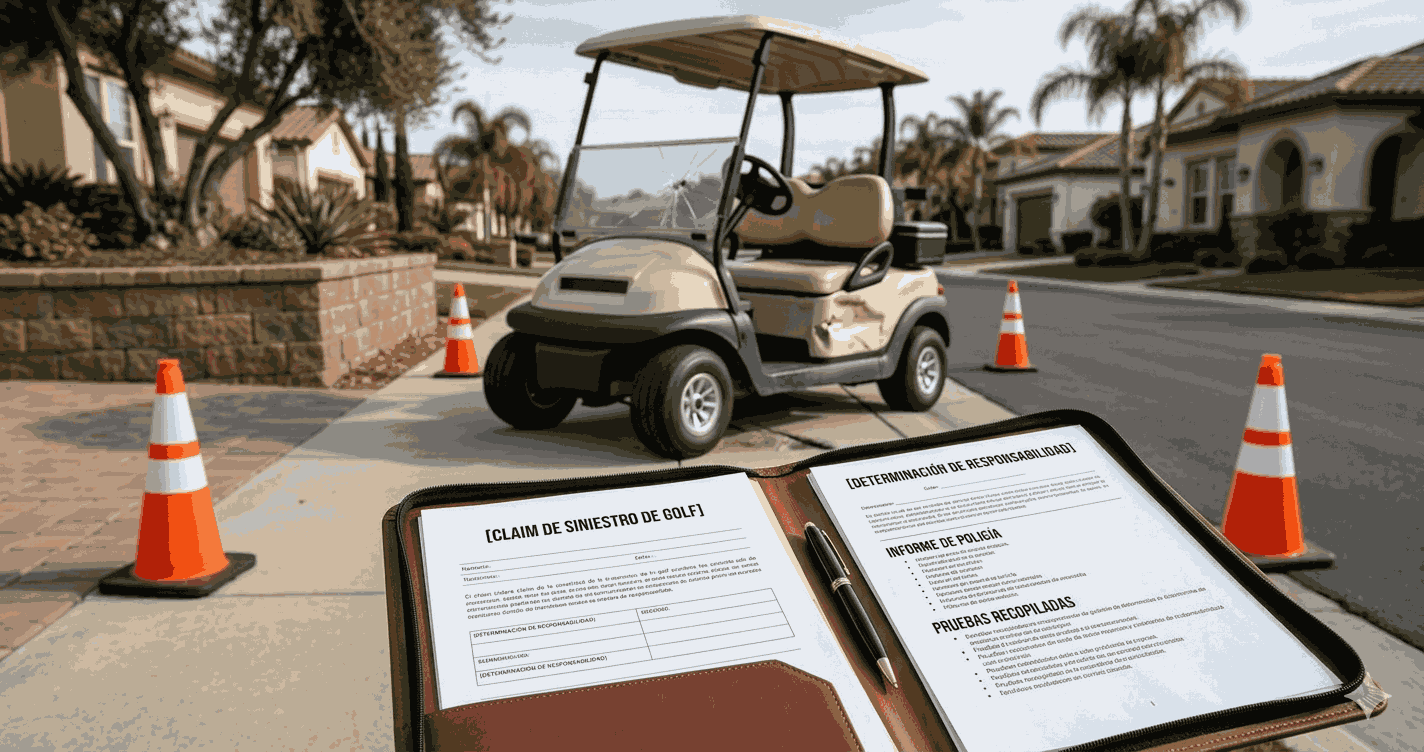
Golf carts are no longer just for the back nine. Today, you will find them cruising through retirement villages, beachside resorts, master-planned neighborhoods, and college campuses. They are fun, open-air, and incredibly convenient. However, because we associate them with leisure, it is easy to forget that they are motorized vehicles.
When a golf cart collides with another vehicle, flips over, or strikes a pedestrian, the lighthearted vibe vanishes instantly. As medical bills and repair estimates roll in, one critical question takes center stage: Who is responsible for a golf cart accident?
Unraveling liability for these low-speed vehicle incidents is surprisingly complex. Because golf carts occupy a legal gray area between pedestrian tools and full-sized automobiles, determining fault requires looking at traffic laws, property rules, and insurance policies.
The Legal Standard for Finding Fault
At its core, a golf cart accident claim relies on the exact same legal principle as a standard car accident: negligence.
To hold someone financially responsible for your injuries or property damage, you must prove that they acted carelessly and that their carelessness directly caused the crash. Legally, this means establishing that the at-fault party breached their “duty of care” to keep others safe.
Because golf carts lack standard safety features like airbags, doors, and crumple zones, a driver’s reckless behavior can cause severe injuries even at 15 miles per hour. Let’s look at the specific parties who are most frequently held responsible when things go wrong.
1. When the Golf Cart Driver Is Liable
In the vast majority of incidents, the person behind the wheel bears primary responsibility. Operating a golf cart demands focus, sobriety, and a respect for physics.
A driver is typically found negligent if the accident was caused by:
-
Distracted Driving: Texting, adjusting a phone, or looking away from the path to chat with passengers.
-
Speeding Around Corners: Golf carts have a narrow track and a high center of gravity. Taking a sharp turn too fast causes the vehicle to tip or launches passengers out onto the pavement.
-
Operating Under the Influence: Driving a golf cart while intoxicated is not only incredibly dangerous, but in many states, it can also lead to a standard DUI arrest.
-
Underage Operation: Allowing young children without a valid driver’s license or proper training to operate a motorized cart on public or community roads.
If you are a passenger injured because your driver took a sharp turn recklessly, that driver is legally responsible for your damages.
2. When a Traditional Car Driver Is Liable
As golf carts increasingly share public roads with traditional passenger cars and SUVs, mixed-vehicle collisions are on the rise. In a matchup between a two-ton SUV and a 1,000-pound golf cart, the occupants of the cart always suffer the worst consequences.
If a standard automobile strikes a golf cart, the car driver is usually held responsible if they:
-
Fail to yield the right-of-way at a designated golf cart crossing.
-
Tailgate a slower-moving golf cart on a neighborhood street.
-
Distractedly drift into a designated golf cart lane.
In these scenarios, navigating the claim is similar to a standard auto accident, and the injured parties will seek compensation from the car driver’s auto liability insurance policy.
3. When the Property Owner or HOA Is Liable
Sometimes, an accident occurs without any driver behaving recklessly. If a crash is caused entirely by the poor condition of the environment, responsibility shifts to the entity managing the property. This falls under a legal concept known as premises liability.
A country club, vacation resort, hotel, or Homeowners Association (HOA) can be held responsible if the crash was caused by:
-
Massive, unmarked potholes or deep cracks on a designated cart path.
-
Blind corners hidden by overgrown, un-trimmed landscaping.
-
A total lack of warning signs near steep, hazardous drop-offs or sharp declines.
-
Poorly designed paths that force carts into dangerous interactions with pedestrian traffic.
Property owners have a legal obligation to maintain safe premises for their guests and residents. If they know about a hazard and fail to fix it or warn visitors, they are on the hook for the resulting damage.
4. When the Rented Cart Company Is Liable
If you rent a golf cart at a beach resort or a golf course, you expect that vehicle to be mechanically sound. If a mechanical failure causes you to lose control, the rental company or fleet owner may be negligent.
Examples of rental company liability include:
-
Brake Failure: Failing to routinely inspect and replace worn-out brake pads.
-
Steering Malfunctions: Ignoring mechanical complaints from previous renters about loose steering columns.
-
Defective Batteries or Tires: Allowing a cart with bald tires or a faulty electrical system out onto the path.
To win a case against a commercial rental entity, you must prove that the company failed to perform standard maintenance, directly resulting in the mechanical failure that caused your crash.
How Liability Splits and Payout Categories
Depending on who is found at fault, golf cart settlements generally scale based on the severity of the negligence and the injuries involved:
Minor Claims ($15,000 – $50,000)
These typically involve minor soft-tissue strains or simple fractures caused by a driver’s sudden stop or minor bump. Payouts cover emergency room bills and basic physical therapy.
Moderate to Severe Claims ($75,000 – $200,000)
These cases usually involve joint fractures or moderate concussions requiring surgery or extensive rehabilitation. They frequently occur when a driver takes a turn too fast, ejecting a passenger onto concrete, or when a homeowner’s policy endorsement pays out up to its limits.
Catastrophic Claims ($250,000 – $1 Million+)
When a commercial resort is grossly negligent, an individual drives under the influence, or a passenger car strikes a cart, injuries can be life-altering. These claims involve traumatic brain injuries (TBIs) or spinal damage, targeting high-limit commercial umbrella policies to secure long-term medical care.
The Insurance Maze: Who Actually Pays?
Once you figure out who is responsible, the next hurdle is figuring out which insurance policy will actually cut the check. This is where golf cart claims get incredibly tricky.
[Golf Cart Accident] ──> Which Path Applies?
                           │
                           ├──> Struck by a Car? ────────> At-Fault Driver's Auto Insurance
                           ├──> On Private Property? ────> Homeowners Liability (With Rider)
                           └──> At a Vacation Resort? ───> Commercial Premises Liability
Standard auto insurance rarely covers a golf cart unless a passenger car was involved in the crash. Instead, compensation usually comes from a specialized recreational vehicle policy, a homeowners insurance liability endorsement (if the crash happened on the homeowner’s property), or a business’s commercial general liability policy.
Step-by-Step Guide to Proving Your Claim
If you have been injured in a golf cart accident, the steps you take immediately afterward will determine whether you can successfully prove who was responsible.
1.Take Comprehensive Photos and Videos:Capture the Scene.
The Trap of Comparative Fault
Keep in mind that insurance companies will do everything they can to shift the blame onto you. Under the legal rule of comparative negligence, your final compensation can be slashed if you contributed to your own injuries.
For example, if a driver turns recklessly and you fall out, but the insurance company proves you were standing up or hanging off the back of the cart while it was moving, a jury might find you 30% at fault. If your total medical bills and suffering equal $100,000, your final payout will be legally reduced to $70,000. Always ride responsibly to protect both your body and your legal rights.
Have you ever been involved in a close call or an accident involving a golf cart? How did the neighborhood or insurance company handle it? Tell us about your experiences in the comments below, and share this guide with your community to keep everyone safe on the paths!
References
-
Surgical Neurology International (2024). Low-speed vehicular trauma and mechanics of occupant ejection.
-
Journal of Trauma and Acute Care Surgery (2023). Evaluating liability patterns and injury severity in recreational vehicle accidents.
-
Insurance Information Institute (2025). Understanding homeowners insurance riders and recreational vehicle exclusions.
