

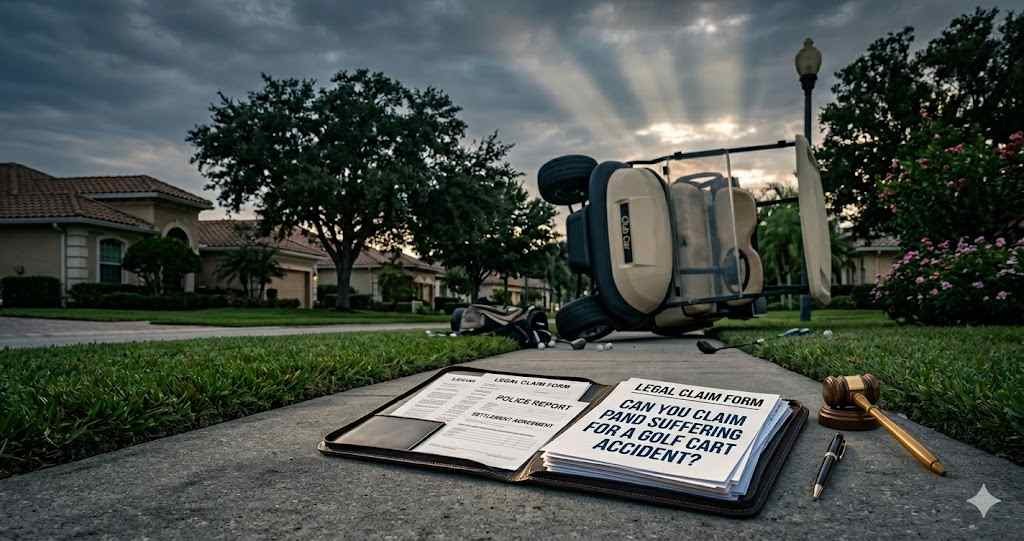
Many people associate golf carts with low-speed relaxation, whether navigating a seaside resort, a master-planned neighborhood, or a local country club. However, because standard golf carts lack the structural safety features of automobiles such as airbags, seat belts, and doors accidents frequently result in severe, life-altering bodily harm.
If you sustain an injury due to someone else’s carelessness, the medical bills and lost wages are only part of the burden. You may also find yourself wondering: Can you legally claim compensation for pain and suffering after a golf cart accident?
The short answer is yes. If your accident was caused by another party’s negligence, you have a legal right to seek financial recovery for your physical pain and emotional distress. However, securing these damages from an insurance company requires navigating a complex and unique legal landscape.
What Exactly Is Pain and Suffering in a Golf Cart Claim?
In a personal injury case, financial losses are divided into economic and non-economic damages. Pain and suffering falls under non-economic damages, meaning it addresses the human cost of the accident rather than an explicit dollar amount printed on a receipt.
Legally, pain and suffering is split into two distinct categories:
Physical Pain and Suffering
This encompasses the actual physical discomfort, agony, and physical limitations directly caused by your injuries. For instance, a compound fracture, a traumatic brain injury (TBI), or deep nerve damage from a rollover can cause persistent, agonizing physical distress during both the initial trauma and the months of rehabilitation.
Mental and Emotional Pain and Suffering
This category addresses the heavy psychological toll of the crash. Examples include:
-
Post-Traumatic Stress Disorder (PTSD) or severe anxiety when riding in open-air vehicles.
-
Depression stemming from a permanent physical limitation or visible scarring.
-
Loss of enjoyment of life, such as being physically unable to play golf, exercise, or tend to your hobbies.
The Legal Threshold: Proving Negligence
Unlike standard auto accidents, which often rely on a state’s “no-fault” car insurance statutes, most golf cart injury claims are governed by traditional negligence principles. To successfully claim pain and suffering, your attorney must establish that another party acted carelessly and caused your injuries.
To build a valid claim, four basic elements must be proven:
-
Duty of Care: The at-fault party had a legal obligation to operate or maintain the vehicle safely.
-
Breach of Duty: They failed that obligation (e.g., driving while distracted, speeding through sharp corners, or ignoring mechanical warning signs).
-
Causation: Their specific careless action directly triggered the crash or ejection.
-
Damages: You suffered real, documented physical and emotional harm as a direct result.
Who Is Targetable for Pain and Suffering Damages?
Depending on how and where the accident unfolded, several different entities can be held legally accountable for your suffering:
-
The Cart Driver: If you were an innocent passenger and the operator drove recklessly, skipped a stop sign, or operated the vehicle while intoxicated, they are directly responsible.
-
A Property Owner or HOA: If a country club, vacation resort, or Homeowners Association fails to clear debris, leaves severe potholes unaddressed, or designs dangerous pathways without warning signs, they can face a premises liability claim.
-
The Cart Owner: If a rental company or individual owner knowingly lends out a vehicle with defective brakes, steering malfunctions, or bad tires, they share direct liability for the resulting crash.
How Insurance Companies Calculate Pain and Suffering
Because there are no objective receipts for emotional trauma or physical agony, insurance adjusters use specific mathematical formulas to estimate a dollar value for your pain and suffering. The two most common methods are:
1. The Multiplier Method
The adjuster takes the total sum of your economic damages (medical bills and lost wages) and multiplies it by a number between 1.5 and 5. A higher multiplier is used for catastrophic, life-altering injuries.
Example: If your surgery bills and missed work total $40,000, and the adjuster assigns a multiplier of 3 due to a severe joint fracture, your pain and suffering valuation would be calculated at $120,000.
2. The Per Diem Method
This method assigns a specific daily dollar rate—often representing a single day’s normal work wages—for every single day you must live with the physical pain and recovery limitations from the date of the crash until you reach Maximum Medical Improvement (MMI).
Step-by-Step Strategy to Maximize Your Claim Value
Insurance adjusters routinely attempt to minimize pain and suffering payouts by arguing that your discomfort is exaggerated, temporary, or pre-existing. To protect your rights, follow these critical steps:
1.Seek and Complete All Medical Treatment:Medical Evidence.
The Complication: Comparative Negligence Limitations
It’s vital to recognize that your personal behavior during the incident can directly reduce your pain and suffering payout. Under standard comparative negligence laws, if you are found partially at fault for your own injuries, your final compensation will be slashed by your percentage of blame.
For instance, if an insurance adjuster proves that you were standing up in a moving cart or dangling your limbs outside the vehicle framework, a jury might find you 20% responsible for your severe fall. If your total calculated damages equaled $100,000, your final settlement would be legally reduced to $80,000.
Have you ever had to negotiate a pain and suffering claim with a stubborn insurance adjuster? What kind of documentation helped your case? Let us know your stories or drop your questions in the comment section below, and share this article to help keep your local community legally informed!
References
-
King Law Firm (2026). Injured in a Golf Cart Accident? How Negligence and Damages Apply.
-
The Pendas Law Firm (2024). Navigating Premises Liability and Unregistered Golf Cart Injury Claims.
-
American Journal of Preventive Medicine (2023). Nationwide analysis of soft tissue and head trauma resulting from low-speed vehicle ejections.
