

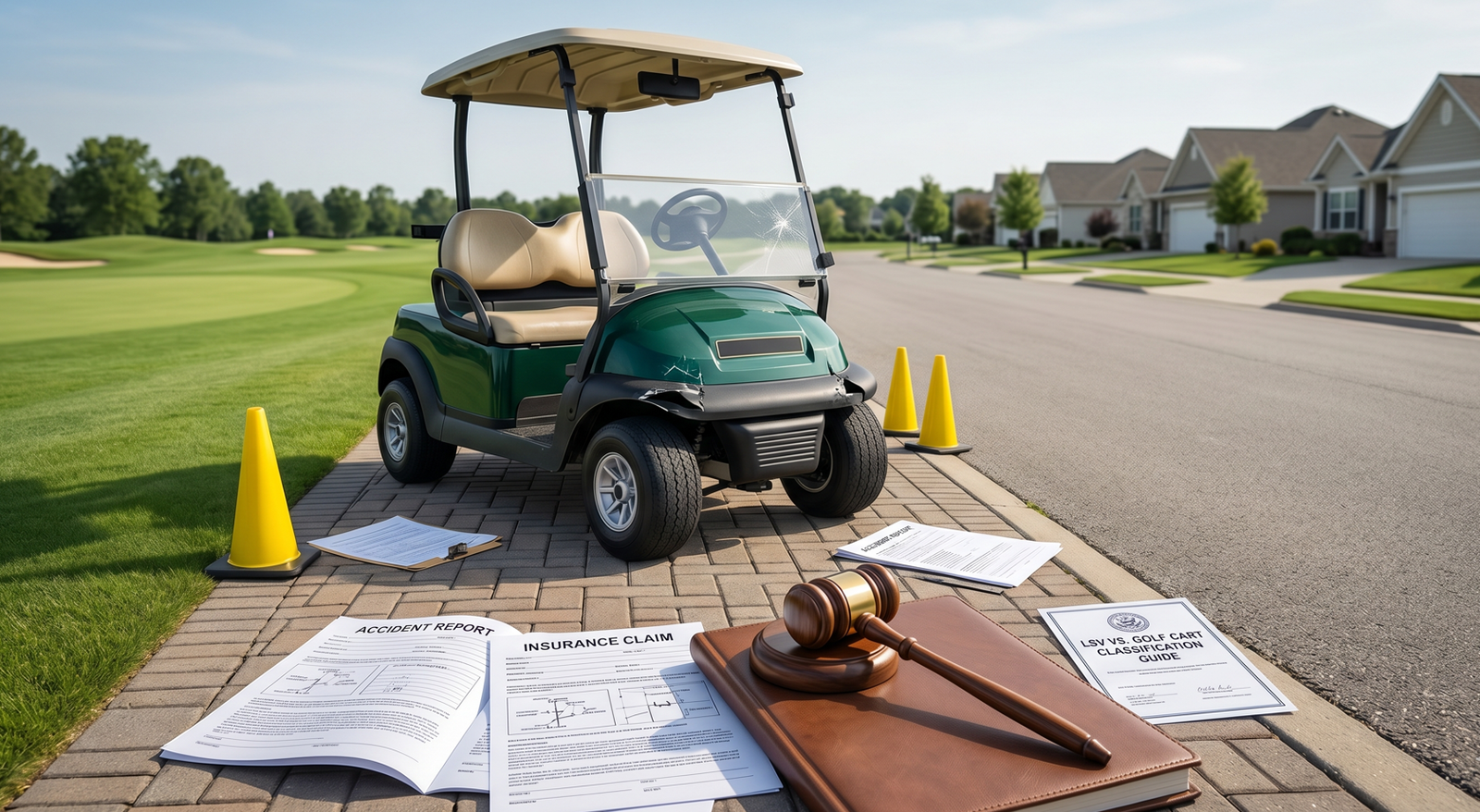
Understanding if Golf Carts Are Legally Considered Motor Vehicles
The humble golf cart has come a long way from simply lugging clubs around eighteen holes. Today, you’ll find them zip around retirement communities, coastal towns, and even busy urban centers. But as these vehicles move from the grass to the asphalt, a pressing legal question arises: Are golf carts considered motor vehicles?
The answer isn’t a simple “yes” or “no.” It depends heavily on where you are driving, how the cart is equipped, and which set of laws you are looking atstate, federal, or insurance-based. This guide will help you navigate the legal maze of golf cart classification so you can stay safe and compliant.
The Legal Definition of a Motor Vehicle
To understand where golf carts fit in, we first need to look at how the law defines a “motor vehicle.” Generally, a motor vehicle is any self-propelled vehicle designed for transporting people or property on public highways.
Under the Federal Motor Vehicle Safety Standards (FMVSS), most standard golf carts do not meet the criteria for “motor vehicles” because they lack specific safety features and are not designed for high-speed road use. However, things change the moment you modify a cart or drive it onto a public street.
When a Golf Cart Becomes a Motor Vehicle
In many jurisdictions, a golf cart transforms from a “recreational vehicle” to a “motor vehicle” or “Low-Speed Vehicle” (LSV) based on its equipment and intended use.
The Low Speed Vehicle (LSV) Classification
If a golf cart is modified to reach speeds between 20 and 25 mph, it may be reclassified as an LSV. According to the National Highway Traffic Safety Administration (NHTSA), once a cart reaches these speeds and is used on public roads, it must meet specific federal safety standards.
To be legally considered a street-legal motor vehicle in most states, the cart must have:
-
Headlamps and tail lamps.
-
Turn signals and stop lamps.
-
Rearview mirrors.
-
A parking brake.
-
A windshield made of safety glass.
-
Seat belts for all passengers.
-
A Vehicle Identification Number (VIN).
State by State Variations
Each state has the authority to define these vehicles differently. For example, Florida has very specific statutes (Florida Statute 320.01) that distinguish between a “golf cart” and a “low-speed vehicle”. If you drive a standard cart on a road where the speed limit is 35 mph, you might be breaking the law because your cart isn’t technically a registered motor vehicle.
Why Classification Matters for Liability
Whether a golf cart is a “motor vehicle” isn’t just a matter of semantics; it has massive implications for insurance and legal liability in the event of an accident.
DUI and Traffic Laws
In almost every state, if you operate a golf cart on a public road, you are subject to the same traffic laws as a car driver. This includes Driving Under the Influence (DUI) laws. Because the cart is “self-propelled,” most courts consider it a vehicle for the purposes of impaired driving statutes, regardless of whether it is registered with the DMV.
Insurance Coverage
Standard auto insurance policies often exclude golf carts unless they are specifically added. Conversely, homeowners’ insurance usually only covers the cart while it is on your private property. If a court determines your cart is a “motor vehicle” during an accident on a public road, and you don’t have proper auto-grade liability insurance, you could be personally responsible for medical bills and damages.
Common Injuries and Safety Risks
Because golf carts are often not treated with the same gravity as cars, safety is sometimes overlooked. However, the lack of a “safety cage” makes them uniquely dangerous in collisions.
-
Ejection Injuries: Without doors or mandatory seat belts in standard models, passengers are frequently thrown from the vehicle during sharp turns or sudden stops.
-
Rollover Accidents: Golf carts have a high center of gravity and a narrow wheelbase. This makes them prone to tipping, which can lead to crush injuries.
-
Traumatic Brain Injuries: Research shows that head trauma is significantly more common in golf cart accidents than in car accidents because of the lack of airbags and structural protection.
Steps to Ensure Your Golf Cart is Legal
If you plan to take your cart off the links and onto the streets, follow this checklist to ensure you are meeting the requirements of a motor vehicle:
-
Check Local Ordinances: Some cities allow carts on streets with speed limits up to 35 mph, while others ban them entirely from public roads.
-
Upgrade Safety Features: If your cart doesn’t have lights, mirrors, and seat belts, it is likely not considered a street-legal vehicle.
-
Register and Title: If your state classifies your cart as an LSV, you must obtain a VIN, title, and license plate.
-
Verify Insurance: Call your agent to ensure you have liability coverage that extends to public roadways.
The Verdict on Classification
So, are golf carts considered motor vehicles?
-
On the golf course: No, they are usually considered recreational equipment.
-
On private property: No, they are generally viewed as personal property.
-
On public roads: Yes, in the eyes of traffic enforcement and liability law, they are often treated as motor vehicles.
Understanding this distinction is the key to protecting yourself both physically and legally.
Do you use a golf cart in your neighborhood? Share this article with your community to make sure everyone is driving legally! Have a question about a specific state law? Comment your thoughts below.
Sources
-
[1] Federal Motor Vehicle Safety Standards (FMVSS) Overview.
-
[2] NHTSA Requirements for Low-Speed Vehicles (49 CFR 571.500).
-
[3] Florida Department of Highway Safety and Motor Vehicles (FLHSMV) – Golf Cart vs. LSV.
-
[4] Case Law Review: Operating a non-traditional vehicle under the influence.
-
[5] Insurance Information Institute (III) – Understanding Golf Cart Insurance.
-
[6] CPSC 2024 Report on Off-Highway Vehicle Stability and Rollovers.
-
[7] PMC 2024 Study: Neurosurgical Injuries in Golf Cart Accidents.
