
In Florida, golf carts are a common sight, serving as a primary mode of transportation in many neighborhoods, retirement communities, and resorts. While these vehicles offer convenience, their proliferation has led to significant legal and safety challenges. Because golf carts are often operated in mixed-traffic environments without the safety features of traditional automobiles, accidents can result in severe, life-altering injuries.
Understanding the complex legal framework governing these vehicles—including their classification, insurance requirements, and liability rules—is essential for anyone operating or riding in a golf cart in Florida.
1. Defining the Vehicle: Golf Carts vs. Low-Speed Vehicles (LSVs)
The most critical legal distinction in Florida is whether a vehicle is a “golf cart” or a “Low-Speed Vehicle” (LSV). This classification dictates everything from registration requirements to insurance mandates.
Golf Carts
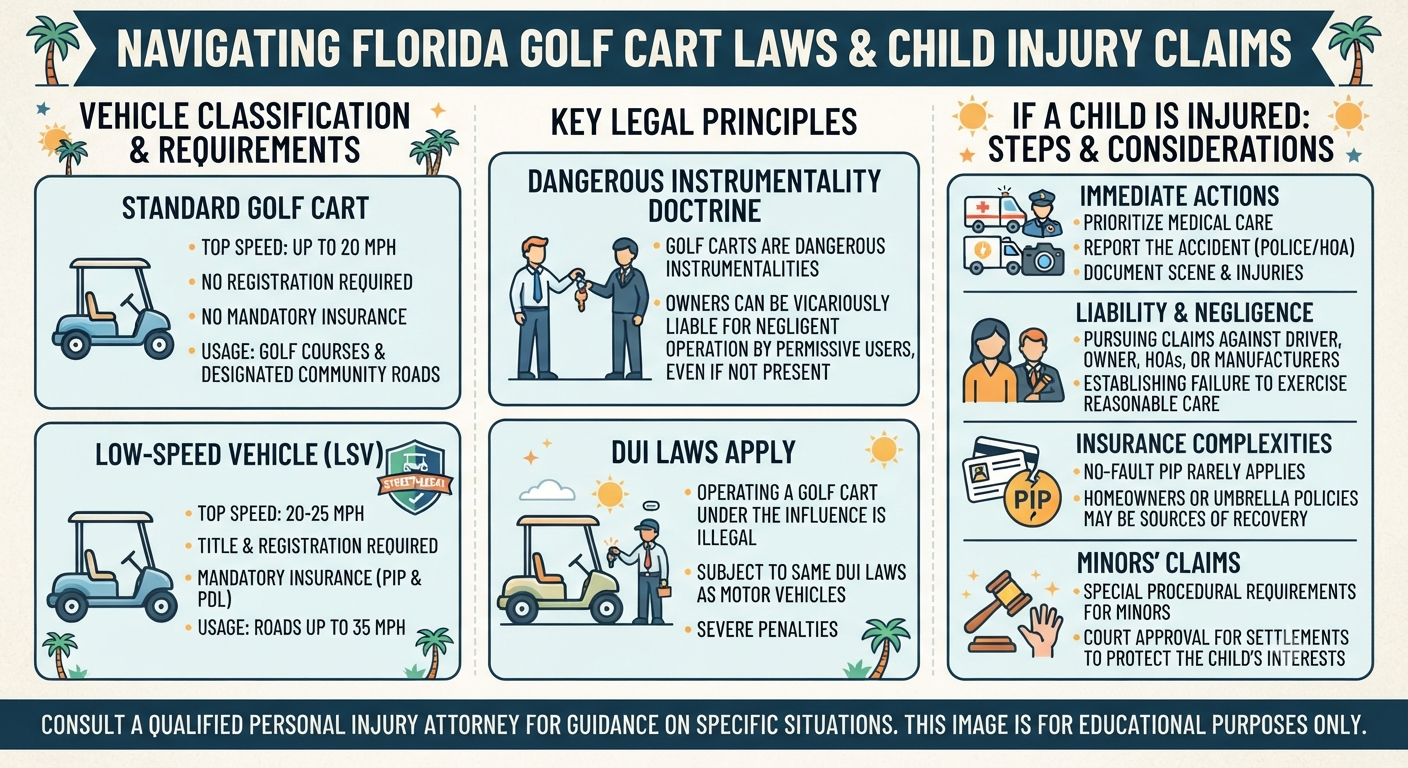
Under Florida Statute § 320.01(22), a golf cart is a motor vehicle designed and manufactured for operation on a golf course for sporting or recreational purposes and is not capable of exceeding 20 mph.
-
Registration and Licensing: Standard golf carts do not require titling or registration.
-
Operational Restrictions: They may only be operated on roads designated for golf carts with a posted speed limit of 30 mph or less.
-
Age Requirements: While no driver’s license is required, operators must be at least 14 years of age to use golf carts on designated public roadways.
Low-Speed Vehicles (LSVs)
An LSV is a four-wheeled vehicle with a top speed greater than 20 mph but not more than 25 mph.
-
Requirements: LSVs must be titled, registered, and insured with at least $10,000 in Personal Injury Protection (PIP) and $10,000 in Property Damage Liability (PDL).
-
Safety Standards: They must be equipped with headlights, brake lights, turn signals, seat belts, and a 17-character VIN.
-
Modification Risk: If a standard golf cart is modified to exceed 20 mph, it is legally reclassified as an LSV and must meet all registration and safety requirements.
2. Liability and the Dangerous Instrumentality Doctrine
Florida law maintains a strict stance on vehicle owner liability through the “Dangerous Instrumentality Doctrine”.
Understanding Vicarious Liability
This doctrine holds the owner of a motor vehicle—including a golf cart—vicariously liable for the negligent operation of the vehicle by anyone to whom they have given permission to use it.
-
Strict Liability: The plaintiff does not need to prove the owner was negligent; once permissive use is established and the driver is found at fault, liability attaches automatically to the owner.
-
Permissive Use: Permission can be express (specifically allowing someone to use the cart) or implied (e.g., leaving keys accessible to a household member who regularly uses the cart).
3. The Reality of Golf Cart DUIs
A dangerous misconception exists that golf carts are exempt from Florida’s DUI laws. Under Florida Statute § 316.193, golf carts are classified as motor vehicles, and operators are subject to the same strict DUI regulations as any other motorist.
-
Location: DUI laws apply broadly across all lands within the state, including golf courses, parking lots, and thoroughfares—even on private property.
-
Penalties:
-
First Offense: Fines between $500–$1,000, potential jail time of up to six months, and license suspension.
-
Aggravating Factors: If a BAC is 0.15 or higher or a minor child is present, fines and jail time increase significantly.
-
Repeat Offenses: Penalties escalate for subsequent convictions, eventually leading to permanent license revocation and lengthy prison sentences.
-
4. Insurance Challenges: The “No-Fault” Gap
Injured Floridians are often “blindsided” by how insurance coverage applies to golf cart crashes.
-
PIP Exclusions: Because standard golf carts are not required to be registered, they are generally excluded from Florida’s “no-fault” PIP coverage.
-
Auto Policy Limitations: Many personal auto policies exclude vehicles “designed mainly for use off public roads,” which often includes golf carts. Owners should review their specific policy definitions and exclusions.
5. Steps to Take After an Accident
If you are involved in a golf cart accident, the following actions are crucial to protect your health and legal rights:
-
Safety and Medical Care: Seek a medical evaluation immediately, as symptoms of internal injuries may be delayed.
-
Report the Accident: Request an official traffic crash report.
-
Comparative Negligence: Under Florida Statute § 768.81(6), if you are found to be greater than 50% at fault for your own harm, you may be barred from recovering any damages.
-
Statute of Limitations: You generally have two years from the date of the injury to file a personal injury claim.
-
Consult an Attorney: Golf cart accidents involve complex insurance and liability issues; professional guidance is vital for evaluating your specific case.
Reference
-
Florida Department of Highway Safety and Motor Vehicles (DHSMV): Golf Cart & Low Speed Vehicle Guidelines
-
Florida Statutes:
-
§ 316.193 (Driving under the influence)
-
§ 320.01(22) (Golf cart definition)
-
§ 768.81(6) (Modified comparative negligence)
-
-
Legal Interpretations:
-
DeLoach, Hofstra & Cavonis, P.A.: Dangerous Instrumentality Doctrine in Florida
-
Swope, Rodante P.A.: Florida Comparative Negligence Law
-
Flynn Law: DUI on a Golf Cart or Bicycle
-
StechLaw Criminal Defense: Can You Get a DUI While Driving a Golf Cart in Florida?
-
CartsMD: Street Legal Golf Cart Guide
-
