

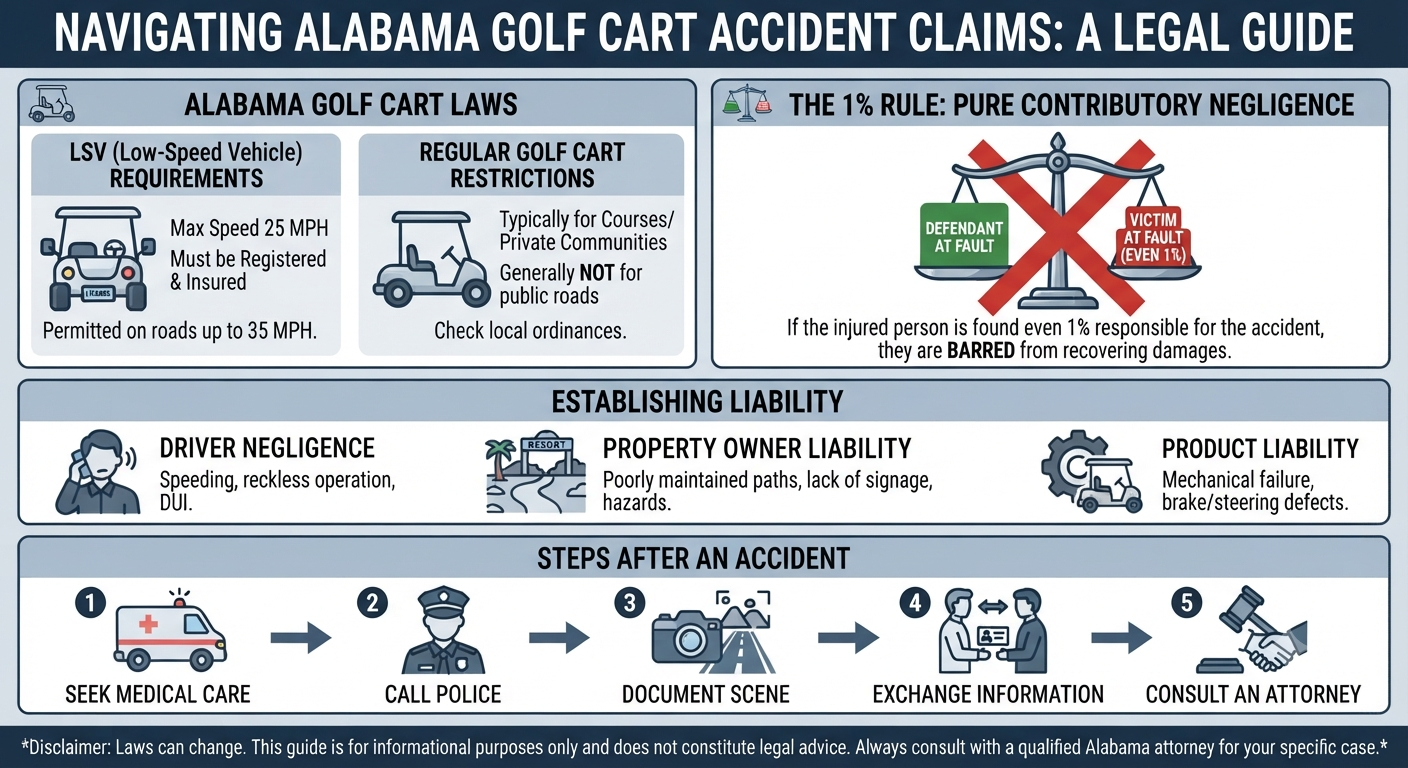
Golf carts are a frequent sight across Alabama’s resorts, golf courses, and private communities. While they offer a relaxed way to navigate these areas, they lack the sophisticated safety features found in traditional automobiles, making occupants highly vulnerable in the event of a collision or rollover. If you have been injured in a golf cart accident, understanding Alabama’s strict legal standards is essential to protecting your right to recovery.
1. The Challenge of “Pure Contributory Negligence”
The most significant hurdle in any Alabama personal injury claim is the state’s adherence to the doctrine of pure contributory negligence.
-
The 1% Rule: Unlike most states that permit partial recovery based on fault, Alabama law completely bars a plaintiff from recovering any damages if they are found to be even 1% at fault for the accident.
-
Impact on Claims: Because even the slightest assignment of blame to the victim can result in a total denial of compensation, insurance companies aggressively investigate incidents to identify any potential fault on your part.
-
Legal Defense: A skilled personal injury attorney is vital to counter these tactics, gather evidence, and ensure that the full burden of fault is placed on the responsible party.
2. Establishing Liability
Liability in a golf cart accident is often multifaceted and requires a thorough investigation to identify all responsible parties:
-
The Operator: If the accident was caused by the driver’s negligence, such as speeding, reckless maneuvering, or operating under the influence, they may be held liable.
-
The Golf Cart Owner: Owners can be held responsible for failing to maintain the vehicle or for “negligent entrustment”—allowing an unlicensed, underage, or incompetent person to operate the cart.
-
Property Owners and Managers: Facilities such as resorts or country clubs have a duty of care to maintain safe premises. If the accident occurred due to poor path conditions, lack of signage, or inadequate lighting, they may face a premises liability claim.
-
Manufacturers and Dealers: If the accident was caused by a mechanical defect, such as a failure in the braking or steering systems, the manufacturer or maintenance contractor may be held strictly liable.
3. Statutes of Limitations
Alabama law imposes strict time limits on when a legal claim must be filed:
-
Two-Year Deadline: The general statute of limitations for filing a personal injury lawsuit in Alabama is two years from the date of the injury.
-
Consequences: Failing to file a lawsuit within this two-year window typically results in the permanent loss of your right to seek compensation, regardless of the strength of your evidence.
4. Immediate Steps After an Accident
Your actions immediately following an accident can significantly impact the outcome of your claim:
-
Seek Medical Care: Get a professional evaluation immediately to document your injuries and treat potential trauma.
-
File an Official Report: Contact law enforcement to create an official police report, which provides an objective account of the incident.
-
Document the Scene: Collect photographs of the environment, any road hazards, the golf cart, and visible injuries, and record contact information for all witnesses.
-
Avoid Statements: Do not provide recorded statements or apologize to insurance adjusters at the scene, as these can be misinterpreted as admissions of fault.
-
Consult Counsel: Reach out to an experienced attorney early to investigate the incident and protect your interests before an insurance company can attempt to shift blame.
Reference
-
Alabama Code § 6-2-38: Statute of limitations for personal injury (2 years).
-
Alabama Civil Jury Instructions: Application of Pure Contributory Negligence.
-
Alabama Pattern Jury Instructions (Civil) 21.01: Premises Liability and Duty of Care.
-
Alabama Supreme Court Precedent: Standard for Negligent Entrustment.
