

Golf carts have become a common mode of transportation across Georgia, particularly in retirement communities, resorts, master-planned developments, and scenic town centers. While these vehicles offer a convenient and relaxed way to travel, their lack of basic safety features—such as seatbelts, standard airbags, and robust structural protection—means that collisions can result in catastrophic injuries. If you or a loved one has been injured in a golf cart accident, navigating the complexities of Georgia law is essential for protecting your legal rights and securing the compensation you deserve.
Establishing Liability in a Golf Cart Accident
In Georgia, golf carts operated on public roads and cart paths can trigger the same insurance and liability analyses as conventional motor vehicle accidents. Determining fault is the cornerstone of any personal injury claim and often involves looking at several potential parties:
-
The Operator: If a driver operates a cart with improper care—such as texting, driving while intoxicated, speeding, or making reckless turns—they may be held liable for resulting injuries.
-
Property Owners and Facilities: Golf courses, resorts, and apartment complexes have a duty to maintain reasonably safe premises. If an accident is caused by poor path maintenance, inadequate lighting, or hazardous conditions on the property that were known to the owner but not the operator, the facility may be liable.
-
Rental Companies: Facilities that rent golf carts are responsible for providing safe, properly maintained equipment. Liability may arise if a company rents to an obviously impaired person, permits a minor to operate a cart without authorization, or fails to conduct required safety screenings.
-
Manufacturers: Golf carts can be considered defective products if they are poorly manufactured or maintained. If a mechanical failure, such as a steering defect or brake malfunction, contributed to the accident, the manufacturer may be held strictly liable.
Georgia’s Modified Comparative Fault Rule
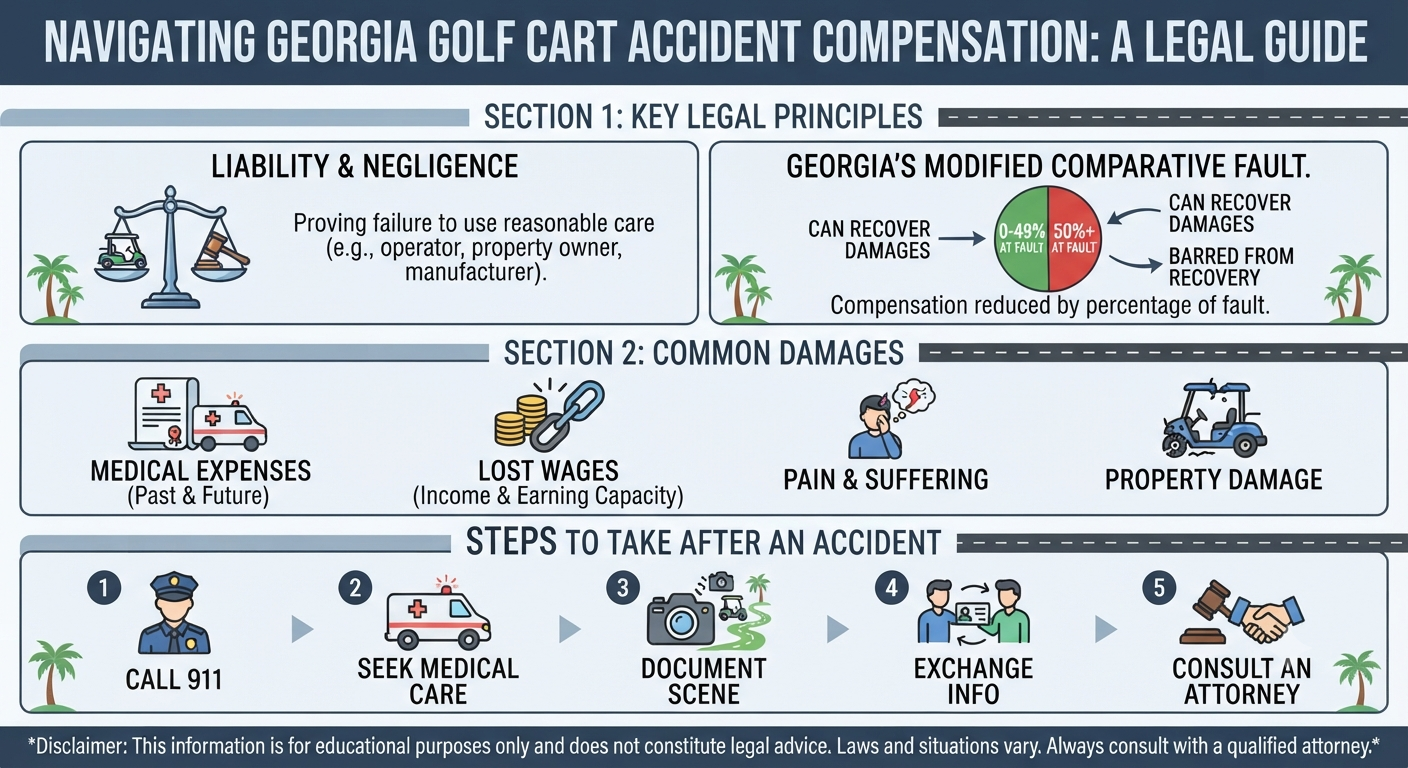
A critical aspect of Georgia personal injury law is the modified comparative negligence system, codified under O.C.G.A. § 51-12-33. This rule dictates how compensation is allocated when the injured party shares some level of responsibility for the accident.
-
The 50% Bar Rule: An injured party may only recover damages if they are found to be less than 50% at fault for the incident. If a judge or jury determines the plaintiff is 50% or more responsible, they are completely barred from recovering any compensation.
-
Proportional Reduction: If the plaintiff is found partially at fault—but below the 50% threshold—their total financial recovery will be reduced by their percentage of responsibility. For instance, if total damages are $100,000 and the plaintiff is 30% at fault, the recovery is reduced to $70,000.
Insurance adjusters often aggressively pursue evidence of partial fault to minimize payouts, sometimes pointing to minor issues like a broken brake light or alleged distraction to shift blame.
Compensation and Recoverable Damages
Georgia law permits victims to recover both economic and non-economic damages, and importantly, there is generally no legal cap on these awards in standard personal injury cases.
Economic Damages
These represent quantifiable financial losses resulting from the injury, including:
-
Past and Future Medical Expenses: Costs for emergency care, surgeries, physical therapy, and long-term rehabilitation.
-
Lost Wages: Compensation for time missed at work during the recovery process.
-
Loss of Earning Capacity: If the injury prevents the victim from returning to their previous job or reduces their ability to earn income in the future.
-
Property Damage: Costs associated with repairing or replacing the golf cart or damaged personal items.
Non-Economic Damages
These address the subjective, emotional, and personal toll of an injury, which can often be the most lasting effect:
-
Pain and Suffering: Chronic pain resulting from the trauma.
-
Emotional Distress: Anxiety, depression, and trauma related to the accident.
-
Loss of Enjoyment of Life: Inability to participate in hobbies or daily activities previously enjoyed.
-
Loss of Consortium: Claims filed by a spouse for the loss of companionship and support.
Important Legal Deadlines
Missing the statute of limitations can permanently bar your claim, regardless of how clear the liability may be.
-
Standard Statute of Limitations: Under O.C.G.A. § 9-3-33, the general deadline for filing a personal injury lawsuit is two years from the date of the accident.
-
Government Claims (Ante Litem Notice): If your accident involves a government entity, you face much stricter deadlines.
-
City/Municipal: Typically requires formal notice of intent to sue within six months.
-
State/County: Requires notice within 12 months of the date the injury occurred or should have been discovered.
-
-
Tolling Exceptions: In rare circumstances, such as if the victim is a minor or mentally incapacitated, the legal clock may be “paused” or tolled until the condition is resolved.
Steps to Take After an Accident
Protecting your health and your legal claim immediately following an incident is crucial:
-
Seek Medical Care: Even if injuries seem minor, get a professional evaluation to detect hidden trauma like internal bleeding or brain injuries.
-
Call 911: Ensure law enforcement arrives to file an official accident report.
-
Document the Scene: Use your phone to photograph the cart, road conditions (e.g., potholes or poor signage), and any visible injuries.
-
Exchange Information: Gather contact details from all parties and witnesses, but avoid making recorded statements or apologizing, as this can be used to assign fault later.
-
Consult an Attorney: Reach out to a personal injury lawyer before speaking with insurance adjusters to ensure your rights are protected from the outset.
Disclaimer: This blog is for educational purposes only and does not constitute legal advice. Laws and circumstances vary; always consult with a qualified personal injury attorney regarding the specific details of your case.
Reference Heading
-
O.C.G.A. § 9-3-33: Statute of limitations for personal injury claims (2 years).
-
O.C.G.A. § 51-12-33: Modified comparative fault rules and apportionment.
-
O.C.G.A. § 50-21-1 et seq.: Georgia Tort Claims Act procedures and notice requirements.
-
Scholle Law: Georgia Golf Cart Accident Lawyer.
-
John Foy & Associates: Personal Injury Damage Caps in Georgia.
-
Farah & Farah: What Is the Personal Injury Statute of Limitations in Georgia?.
-
Gillette Law, P.A.: Jekyll Island Personal Injury Attorney.
-
South Atlanta Injury Lawyers, LLC: Golf Cart Accident Lawyer.
