

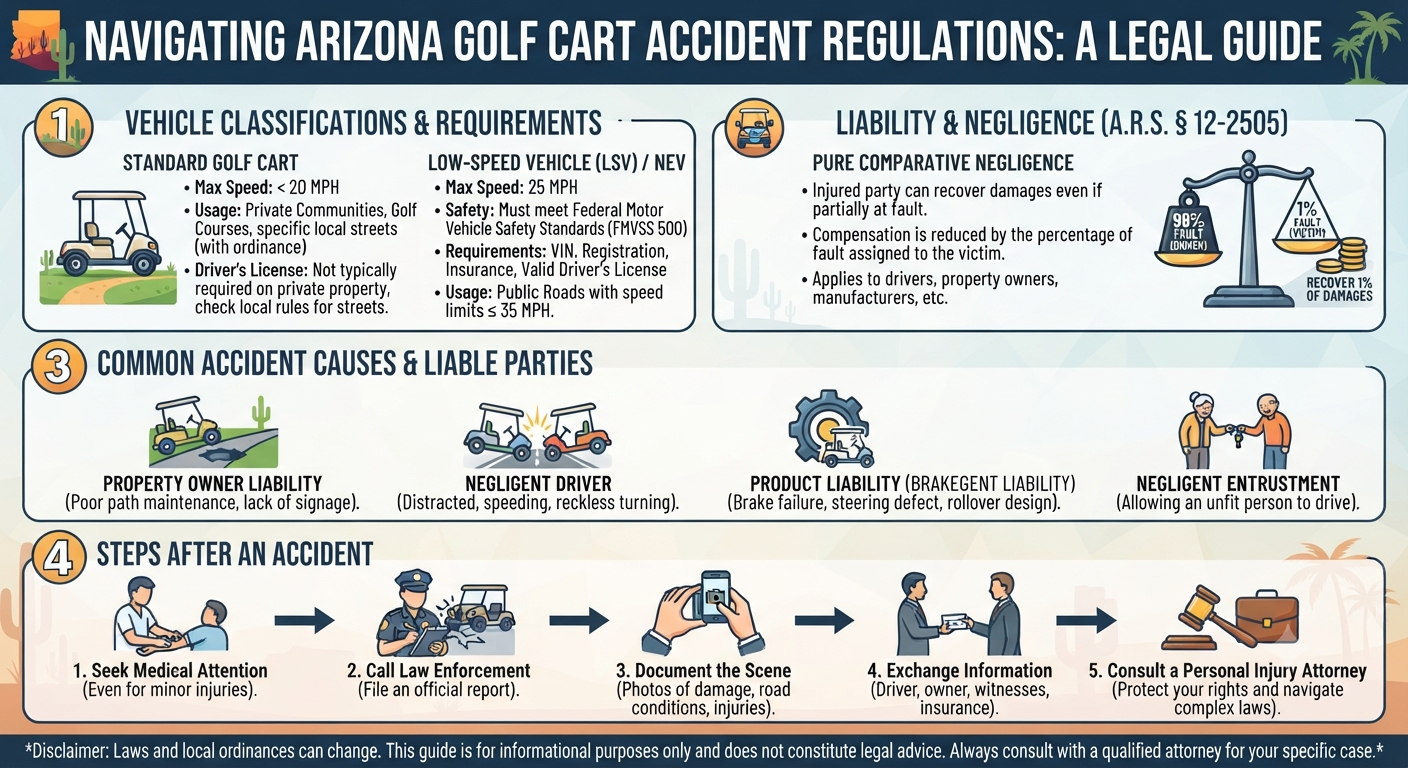
In Arizona, golf carts are more than just recreational vehicles—they are a primary mode of transportation in many retirement communities, master-planned developments, and scenic resort towns. While they provide a relaxed way to enjoy the desert lifestyle, their increased presence on and near public roadways has led to a rise in accidents. Because golf carts offer minimal protection compared to standard passenger vehicles, injuries in these collisions can be particularly severe.
If you have been involved in an accident in Arizona, understanding the state’s specific regulations and how they impact your personal injury claim is essential for protecting your legal rights.
1. Arizona’s Vehicle Classifications
Arizona law distinguishes between different types of low-speed vehicles, which dictates where they can be driven and what safety requirements apply:
-
Golf Carts: Defined as motor vehicles designed for transporting people on a golf course. Under Arizona law, they may be operated on public streets in certain jurisdictions, provided they meet specific local ordinances.
-
Low-Speed Vehicles (LSVs): These are four-wheeled motor vehicles that can attain speeds between 20 and 25 mph. Unlike standard golf carts, LSVs must be registered, titled, and insured. They are equipped with safety features like seatbelts, headlights, turn signals, and mirrors, allowing them to legally operate on public roads with speed limits up to 35 mph.
2. Liability and Negligence in Arizona
Arizona operates under a Pure Comparative Negligence system (A.R.S. § 12-2505). This is a critical legal principle for your injury claim:
-
Recovery Regardless of Fault: Unlike states with a “bar” at 50% or 51% fault, Arizona allows you to recover damages even if you are found to be 99% at fault for the accident.
-
Reduction of Damages: Your total compensation will be reduced by your percentage of fault. For example, if you are 60% responsible for an accident, you can still recover 40% of your total damages.
-
Liability Complexity: Because of this system, insurance adjusters often aggressively pursue evidence of partial fault to minimize their payout. Proving the negligence of the other driver, the property owner (for poor road maintenance), or the manufacturer (for mechanical failure) is vital to ensuring you receive fair compensation.
3. Important Legal Deadlines
In Arizona, you must be aware of the Statute of Limitations:
-
For most personal injury claims resulting from a golf cart accident, you have two years from the date of the incident to file a lawsuit in civil court.
-
If your claim involves a public entity (such as a city-owned golf course or a municipal road), there are stricter “Notice of Claim” requirements that may require you to file formal notice within 180 days of the injury. Missing these deadlines can permanently bar your claim.
4. Steps to Take After an Accident
-
Seek Medical Care: Prioritize your health immediately. Some injuries, such as traumatic brain injuries or spinal trauma, may not be apparent until hours after the crash.
-
Report the Incident: Contact local law enforcement to ensure a formal accident report is filed. This is crucial for establishing a record of the event.
-
Document the Scene: Photograph the golf cart, the condition of the road (e.g., uneven surfaces, lack of signage), and any visible injuries.
-
Gather Information: Collect contact and insurance details from the driver, the golf cart owner, and any eyewitnesses.
-
Consult a Professional: Given the complexity of comparative negligence and potential municipal notice requirements, consult with a personal injury attorney early to preserve your claim.
Reference Heading
-
Arizona Revised Statutes (A.R.S.): Title 28, Transportation (Governing motor vehicles and LSV regulations).
-
A.R.S. § 12-2505: Comparative Negligence Statute.
-
A.R.S. § 12-821.01: Notice of Claim Requirements for Public Entities.
-
Arizona Department of Transportation (ADOT): Low-Speed Vehicle Title and Registration Guidelines.
-
Arizona Courts Self-Help Center: Statutes of Limitations for Personal Injury Claims.
