
Golf carts are a common sight in California, from sprawling golf courses to gated communities and resort properties. While they are often viewed as casual, recreational vehicles, their lack of traditional safety features—such as seatbelts, airbags, and protective frames—means that accidents can result in serious, life-threatening injuries.
If you are involved in a golf cart accident, understanding who may be held liable is the first step in protecting your legal rights and securing compensation.
1. Defining the Vehicle: A Crucial Distinction
In California, the legal rules and insurance requirements for your vehicle depend on its classification.
-
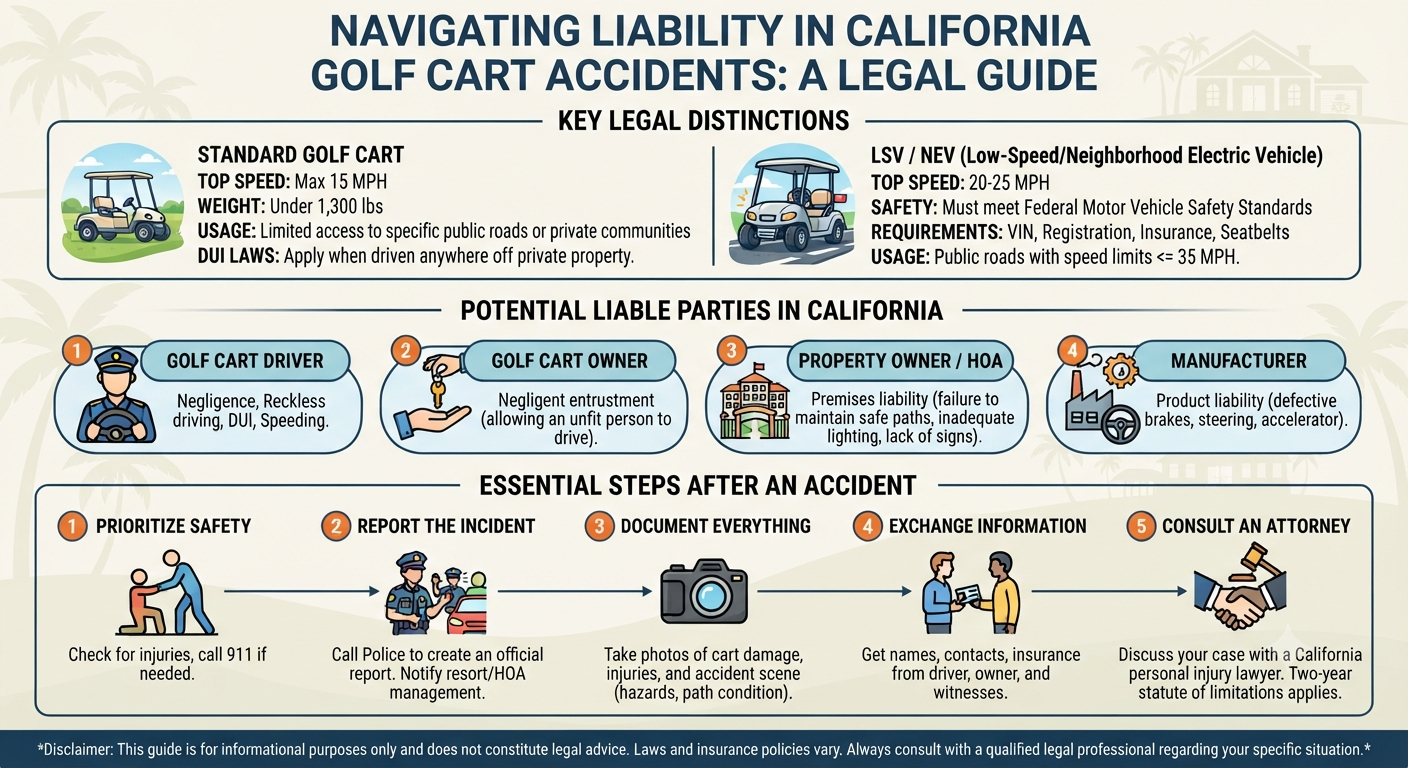
Standard Golf Carts: Under California Vehicle Code (CVC) Section 345, a standard golf cart is a four-wheeled motor vehicle with an unladen weight of less than 1,300 pounds and a maximum speed of 15 mph. These vehicles have very limited access to public roads.
-
Low-Speed Vehicles (LSVs) / Neighborhood Electric Vehicles (NEVs): Regulated under CVC Section 385.5, these vehicles are capable of speeds between 20 mph and 25 mph. Unlike standard golf carts, they must meet federal safety standards, possess a 17-digit VIN, and be registered and insured to operate on public roads with speed limits of 35 mph or less.
Important: Because these vehicles are classified as motor vehicles when operated on public roads, California DUI laws apply to them just as they would to a car.
2. Who Can Be Held Liable?
Determining liability is often complex because multiple parties may share responsibility for an accident. Potential defendants in a California golf cart case include:
-
The Golf Cart Driver: A driver may be held liable if they were negligent or reckless, such as by speeding, making dangerous maneuvers, or operating the cart while intoxicated.
-
The Golf Cart Owner: Owners may be held responsible for injuries if they were negligent in allowing an unfit or inexperienced person to operate their cart.
-
Property Owners and HOAs: Under premises liability, resorts, golf courses, or homeowners’ associations (HOAs) have a duty to maintain safe conditions. If they fail to address known hazards—such as poorly maintained paths, inadequate lighting, or lack of proper warning signs—they may be held liable for resulting accidents.
-
The Manufacturer: If an accident is caused by a mechanical failure—such as defective brakes, steering, or an accelerator malfunction—the manufacturer may be held liable for producing an unreasonably dangerous product.
3. California’s “Pure Comparative Negligence” Rule
California follows a “pure comparative negligence” approach. This means that even if you were partially at fault for the accident, you may still be able to recover compensation from other responsible parties. However, your total damages will be reduced by the percentage of fault attributed to you.
4. Immediate Steps After an Accident
Taking the right steps immediately after an incident is critical to preserving your claim:
-
Prioritize Safety: Ensure everyone is safe and call 911 if there are serious injuries.
-
Report the Incident: Call the police to ensure an official investigation and report are prepared. For resort or community accidents, notify management or the HOA as well.
-
Document Everything: Take photographs of the golf cart, the accident scene, and any hazardous conditions.
-
Preserve Evidence: Keep medical records, receipts, and incident reports. Avoid repairing or altering damaged personal property until it has been properly documented.
-
Consult an Attorney: California has a two-year statute of limitations for filing personal injury claims. Missing this deadline may permanently bar you from recovering damages.
-
Reference
-
Gomez Trial Attorneys: “California Golf Cart Accident Lawyer”
-
KAASS Law: “Golf Cart Personal Injury Accidents at California Resorts”
-
Krolikowski Law Firm: “7 Powerful Winning Tips 2025”
-
City of Laguna Woods: “Guide to Golf Cart and Low-Speed Vehicle Use”
-
Victims Lawyer: “California Comparative Fault Law”
-
California Courts Self-Help Guide: “Deadlines to sue someone”
-
