

Finding yourself or a loved one injured in a golf cart accident is traumatic, physically and emotionally. The last thing you need is more financial stress. When you begin your search for legal help, your first thought is often, “How much is this going to cost me?“
This article is designed to provide you with a comprehensive, transparent guide to golf cart accident lawyer fees. We will move beyond vague answers to explain exactly how the standard fee structures work, what additional costs you must consider, and how a legal fee ultimately relates to the value a lawyer adds to your settlement.
1. The Standard Fee Structure: Contingency Fees
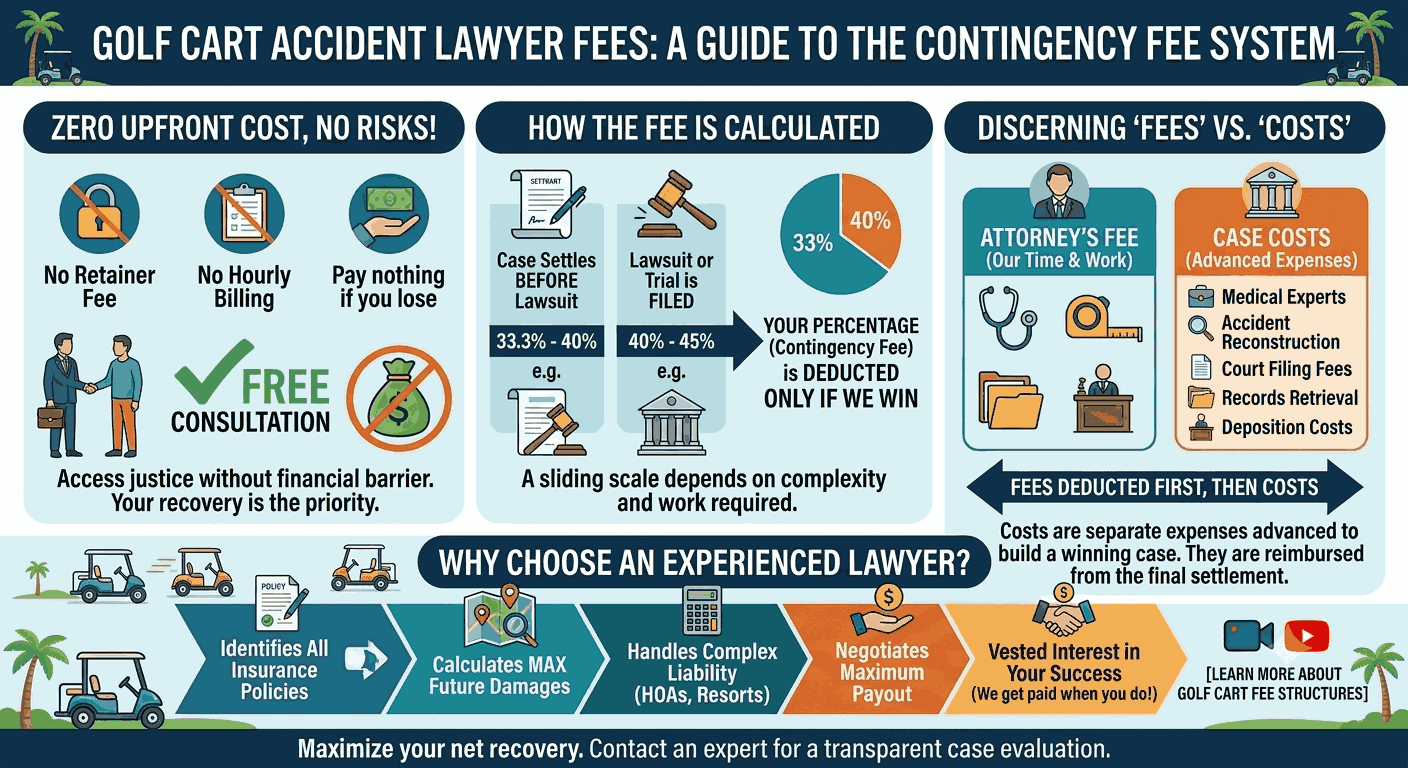
Almost all personal injury and accident lawyers, including those specializing in golf cart cases, work on a Contingency Fee basis.
A contingency fee is a straightforward and mutually beneficial arrangement designed so that everyone, regardless of financial means, has access to quality legal representation. It can be summarized in three points:
-
Zero Upfront Cost: You do not pay your lawyer a single dollar to get started. They take your case without requiring any initial cash.
-
No Hourly Billing: Your lawyer will not send you monthly bills for “billable hours” spent on research, calls, or drafting documents.
-
Payment is Contingent Upon Winning: The lawyer only gets paid if they successfully recover money for you—either through a negotiated settlement (the vast majority of cases) or a jury award. If they lose your case, they receive no fee.
2. Understanding the Contingency Percentage
If your lawyer wins your case and secures a payout for you, their payment will be a predetermined percentage of that gross recovery. This percentage must be clearly outlined in your Retainer Agreement, the formal contract you sign when hiring them.
While percentages can vary slightly by lawyer and jurisdiction, they generally fall into standard bands:
A. Pre-Litigation (Settlement) Fees
For cases that settle before a formal lawsuit is filed, the standard contingency fee is typically 33.3% to 40%.
-
This range covers the extensive work of investigation, evidence gathering (witness statements, police reports, accident recreation), medical record organization, calculation of total damages, and initial negotiations with insurance adjusters.
B. Litigation (Lawsuit) Fees
If your lawyer must file a lawsuit to force the insurance company or at-fault party to offer a fair settlement, the risk, complexity, and resource investment increase dramatically. Consequently, the fee percentage often increases, typically to 40% to 45%.
-
This higher percentage is to compensate for the significant resources (time, money, and advanced legal skill) required to litigate, including the formal discovery process (depositions, written questions, request for documents), motions, and trial preparation.
3. Discerning “Fees” vs. “Case Costs”
This is perhaps the most misunderstood aspect of hiring an accident lawyer. It is critical that you distinguish between the Legal Fee (the contingency percentage) and Case Costs (the hard, out-of-pocket expenses your lawyer pays to build your case).
While the lawyer’s time and effort are covered by the percentage, building a winning golf cart case incurs separate expenses. These are the expenses your lawyer will “advance” on your behalf. These costs will be reimbursed to the law firm from your portion of the final settlement after the lawyer’s fee is deducted.
Common Advanced Case Costs Include:
-
Medical Records Retrieval Fees: Paying hospitals and providers to send official, comprehensive records.
-
Police and Official Report Fees: Costs to obtain official accident reports.
-
Accident Reconstruction Expert Fees: Hiring a professional to recreate the crash, prove fault, or dispute the insurer’s liability assessment (often a five-figure expense).
-
Medical Expert Review Fees: Hiring a doctor to review your injuries and testify to their severity or permanence.
-
Court Filing Fees: Expenses to formally file the lawsuit.
-
Court Reporter and Deposition Fees: Costs for transcription and reporting services during discovery.
-
Postage, Copies, and Miscellaneous Expenses.
4. How Case Costs Affect Your Payout
When you receive your final settlement check, the process involves two distinct steps:
-
Deduction of the Legal Fee: The law firm’s contingency percentage is deducted first from the total gross recovery.
-
Dedu reimbursement of Advanced Case Costs: The total sum of advanced out-of-pocket expenses is deducted second, directly from your remaining share of the settlement.
It is therefore your net recovery—the amount you keep—that matters most. A higher contingency percentage can be more than offset by a lawyer who can win a significantly larger gross settlement.
Two Final Questions on Costs (That You MUST Ask Your Lawyer):
-
Are your advanced costs deducted before or after the lawyer’s fee is calculated? (Standard is before, meaning the lawyer’s percentage is on the larger “gross” amount.)
-
What if we lose? Do I owe any of the advanced case costs? (This is a vital point of trust. Many (but not all) contingency lawyers structure their agreements so that if the case is lost, you owe nothing—neither fees nor costs. Always confirm this is the case in writing before you sign.)
5. What Value Are You Paying For?
A contingency fee is a “get-paid-what-you’re-worth” model, not a low-cost service. By giving your lawyer a vested interest in your success, you are paying for professional legal skill, vast investigative resources, and unparalleled negotiating power that you cannot access on your own.
A specialized golf cart accident lawyer understands:
-
Complex Liability: Investigating the complex interplay of liability in non-standard vehicles, such as negligent drivers (including uncertified minors), property owner/HOA responsibility, or manufacturer defect.
-
Navigating Unique Insurance: Identifying specialized golf cart or recreational vehicle policies that standard auto adjusters overlook.
-
Identifying Umbrella Liability: Locating all layers of coverage to ensure your damages can be paid, regardless of the at-fault driver’s low initial policy limits.
-
Maximum Economic Damages: Meticulously calculating and substantiating all direct financial losses, including complex loss of future earning capacity or lifetime medical expenses.
-
High Multiplier for Pain and Suffering: Crafting an unshakeable argument for a much higher “pain and suffering” multiplier that reflects the real human impact of your injuries.
An excellent lawyer’s goal is not simply to settle your case, but to maximize your total gross recovery so that your net payout (after fees and costs) is far greater than anything you could achieve alone.
Do you have questions about a recent golf cart accident? Are you facing pressure from an insurance company and need to know the next right step? Contact our experienced legal team for a free, no-obligation consultation.
References
-
American Bar Association (2026). Understanding Lawyer Fee Arrangements.
-
Pivotal Variables That Can Drastically Alter Your Payout (2026).
-
How To Handle A Denied Golf Cart Accident Insurance Claim (2026
