

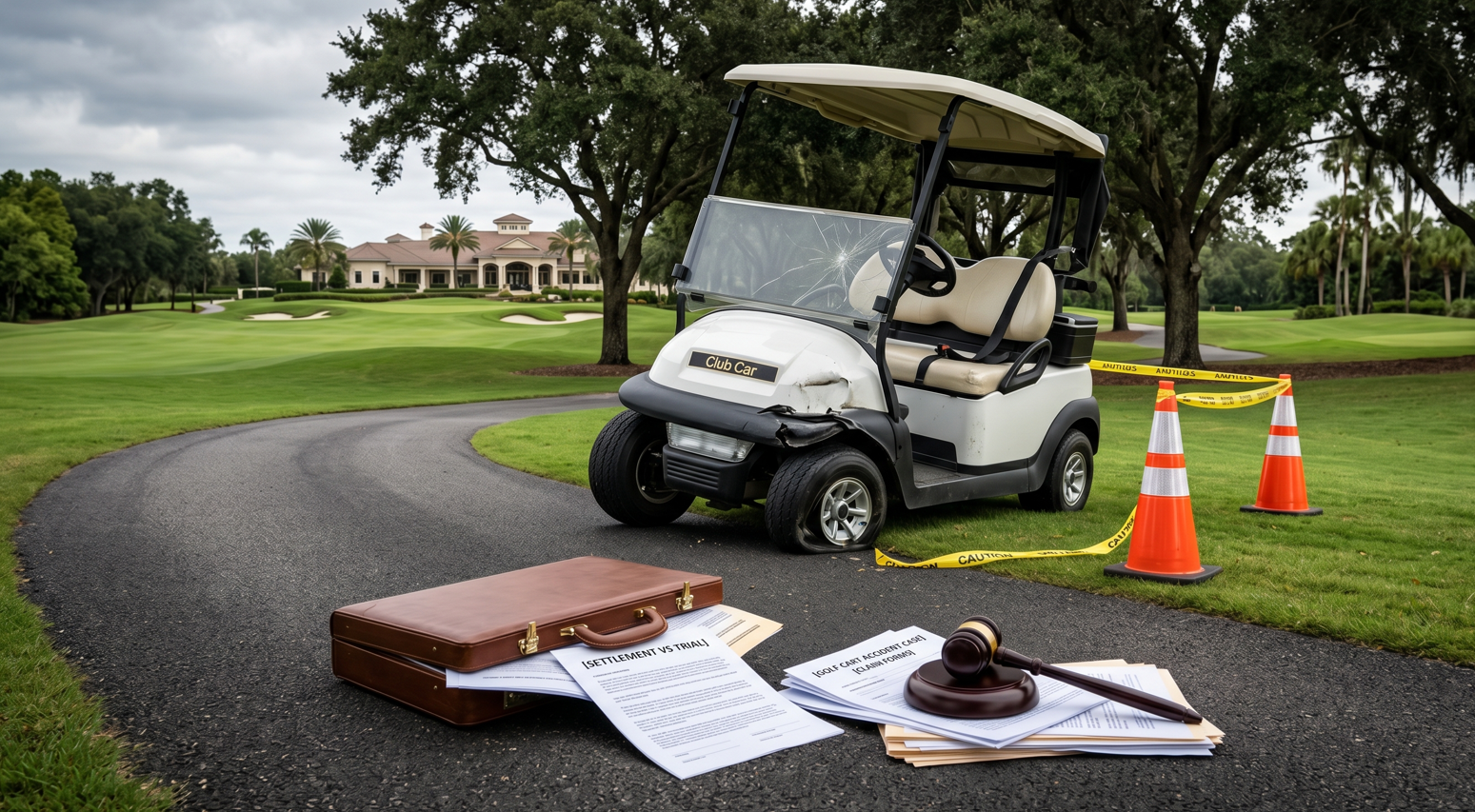
Settlement Versus Trial Golf Cart Accident Case
Imagine cruising down a sun-drenched pathway in a beach community or heading to the tenth hole. Suddenly, the golf cart takes a sharp turn, flips, or collides with a passenger car. In a flash, a relaxing afternoon transforms into a whirlwind of medical bills, police reports, and immense stress.
As your medical expenses climb, you are faced with a monumental legal crossroad: should you resolve your injury claim through a private settlement, or should you take your case all the way to a courtroom trial?
Choosing between a settlement and a trial dictates how fast you receive financial recovery, how much compensation you ultimately take home, and the amount of stress you will endure. This expert guide breaks down both paths logically so you can make the absolute best decision for your physical and financial recovery.
The Rising Danger of Golf Cart Accidents
Golf carts feel light and recreational, but the legal and physical realities are much heavier. Modern personal transport vehicles (PTVs) and low-speed vehicles (LSVs) frequently travel at speeds between 15 and 25 mph. Yet, they lack standard automotive safety features like airbags, doors, and reinforced steel crumple zones.
According to data compiled by the U.S. Consumer Product Safety Commission (CPSC), golf cart accidents lead to thousands of emergency room visits annually, with data from 2023 showing a staggering 26,279 ER trips nationwide. The CPSC reports that passenger ejections account for roughly 40% of these incidents, frequently causing severe head trauma, broken limbs, and spinal injuries.
When these severe injuries occur, the financial stakes skyrocket, making your choice of legal strategy absolutely critical.
What Does It Mean to Settle a Golf Cart Case?
A settlement is an out-of-court agreement where you accept a specific, guaranteed sum of money from the at-fault party or their insurance company. In exchange for this financial payout, you sign a release form promising that you will drop all current and future legal claims related to that specific accident.
The Perks of Settling
-
Speed and Efficiency: Settlements bypass the clogged court systems. You can wrap up a solid settlement within months of reaching your maximum medical improvement (MMI), rather than waiting years for a court date.
-
Guaranteed Payout: You know exactly how much money is coming your way. There is zero risk of walking away empty-handed.
-
Privacy: Out-of-court settlements are entirely confidential. Your medical history and financial details remain out of the public record.
-
Lower Litigation Costs: Fewer hours billed by attorneys, no expensive expert witness fees for courtroom testimony, and no court filing fees mean more money stays in your pocket.
The Drawbacks of Settling
-
Lower Caps: Insurance adjusters are professional negotiators. They will fight to settle for the lowest possible amount, often capping the deal at the absolute limit of the policy.
-
Finality: If you discover a year from now that your back injury requires an additional $50,000 surgery, you cannot reopen the case. You are entirely on your own.
What Does Taking a Case to Trial Involve?
If the insurance company refuses to offer a fair payout, your attorney may recommend taking the case to trial. Here, your legal team presents evidence before a judge or a jury, who will ultimately decide who is at fault and exactly how much compensation you deserve.
The Perks of Going to Trial
-
Maximum Financial Payout: Juries are driven by human empathy, logic, and emotion. If an insurance company lowballs a catastrophic injury, a jury can award a verdict that far exceeds what the insurer ever would have offered voluntarily.
-
Punitive Damages: If the golf cart driver was operating the vehicle while highly intoxicated, a jury can award punitive damages specifically designed to punish the wrongdoer.
-
Public Accountability: A public trial forces property owners, negligent resorts, or manufacturing corporations to answer for unsafe practices on the record.
The Drawbacks of Going to Trial
-
The “All or Nothing” Risk: Trials are unpredictable. A conservative jury could decide you were partially at fault for the accident, drastically reducing your award or leaving you with nothing at all.
-
Extensive Time Delays: A personal injury trial can drag on for two to four years, especially if the defense appeals the initial verdict.
-
Sky-High Stress Levels: You will likely have to testify under oath, face aggressive cross-examination from defense lawyers, and relive the trauma of the crash in public.
Comparing the Paths: Settlement vs. Trial
To give you a clear, scannable look at how these two paths stack up, let’s look at the core differences:
| Feature | Out-of-Court Settlement | Courtroom Trial |
| Timeframe | Fast (typically 3 to 9 months) | Long (can take 1 to 3+ years) |
| Financial Outcome | Predictable, guaranteed amount | Unpredictable (high risk, high reward) |
| Publicity | Entirely private and confidential | Completely public record |
| Final Decision Maker | You and your personal injury lawyer | A judge or a random 12-person jury |
| Average Legal Expenses | Low to moderate | High (expert fees, deposition costs) |
Core Factors That Dictate Which Path You Choose
Every accident involving a personal transport vehicle is completely unique. Attorneys generally weigh four critical elements before advising you to sign a settlement or file a formal lawsuit.
1. The Strength of the Evidence
If you have pristine video footage of the accident, a clear police report, and undeniable medical data linking your injury to the impact, the insurance company will likely offer a substantial settlement to avoid losing badly in court. If liability is murky, a settlement minimizes your financial risk.
2. The Severity of Your Medical Injuries
Minor soft-tissue sprains rarely justify the immense financial cost of a courtroom trial. However, catastrophic spinal cord harm, compound fractures requiring orthopedic surgery, or traumatic brain injuries often demand a trial if insurers refuse to pay for the victim’s long-term medical care and lifelong loss of earning capacity.
3. The Type of Insurance Policy in Play
Golf cart insurance is notoriously complicated. Standard auto insurance often explicitly excludes accidents involving low-speed utility vehicles. If you are suing a private individual whose only coverage is a small $25,000 homeowner’s policy, going to trial is generally pointless because you cannot collect money that simply doesn’t exist. Conversely, if you are fighting a wealthy resort or a commercial golf course with a multi-million dollar liability policy, a trial becomes a viable path to secure true financial justice.
4. Comparative Fault Rules
States handle fault differently. Under comparative negligence laws, if a jury finds that you were 20% at fault for your own injury (for example, by standing up while the cart was in motion), your overall financial award is slashed by exactly 20%. If your state follows strict contributory negligence rules, being even 1% at fault can completely barred you from recovering any compensation in court, making an early settlement your only realistic option.
Step-by-Step: The Timeline of a Legal Claim
Whether your case wraps up in an office or a courtroom, almost every golf cart injury claim follows this foundational progression:
[Medical Treatment & MMI] ➔ [Evidence Gathering] ➔ [The Demand Letter] ➔ [Negotiation] ➔ [Settlement OR Trial]
Reaching Maximum Medical Improvement (MMI)
Never settle your case while you are still wearing a cast or undergoing active diagnostic testing. You must reach MMI the point where your doctors determine your physical condition has stabilized as much as medically possible to calculate the exact future costs of your rehabilitation and lifelong care.
Investigation and Fact Gathering
Your legal team compiles medical bills, wage loss statements, eyewitness interviews, and expert analysis regarding the structural damage to the golf cart.
Sending the Demand Letter
Your attorney issues a comprehensive formal demand to the insurance carrier. This document outlines the explicit details of the crash, provides evidence of the driver’s negligence, and requests a specific financial figure to resolve the matter quietly out of court.
Intensive Negotiation
The insurer will return with a counteroffer. This begins a tactical back-and-forth process. If they act reasonably, the case settles here. If they try to minimize your hardships, your lawyer files a formal lawsuit to prepare for a courtroom trial.
Essential Tips for Injured Victims
-
Preserve Digital Evidence: Download any phone photos or dashcam footage of the golf cart’s position, tire tracks, and the surrounding terrain immediately.
-
Keep a Pain and Limitations Diary: Document the daily tasks you can no longer perform independently. Juries and adjusters respond powerfully to concrete, real-world examples of how a broken bone or neck injury upended your daily lifestyle.
-
Stay Completely Off Social Media: Never post updates about your physical recovery, vacations, or gym visits while your claim is active. Defense attorneys will routinely weaponize innocent family photos to argue that your pain is entirely fabricated.
Conclusion: Weighing Your Best Path Forward
Ultimately, over 90% of personal injury cases are successfully resolved via out-of-court settlements. Settling gives you speed, peace of mind, and financial certainty so you can move forward with your life without the looming shadow of a courtroom battle. However, if an insurance conglomerate acts in bad faith or refuses to cover your long-term medical care, a trial stands as your ultimate shield to secure the compensation you rightfully deserve.
Did this guide help you understand the core differences between a settlement and a trial? Share this article on social media to keep your friends and family informed about their legal rights!
Are you currently weighing your options after an unexpected cart accident? Comment your thoughts below to share your experience or ask a question.
