

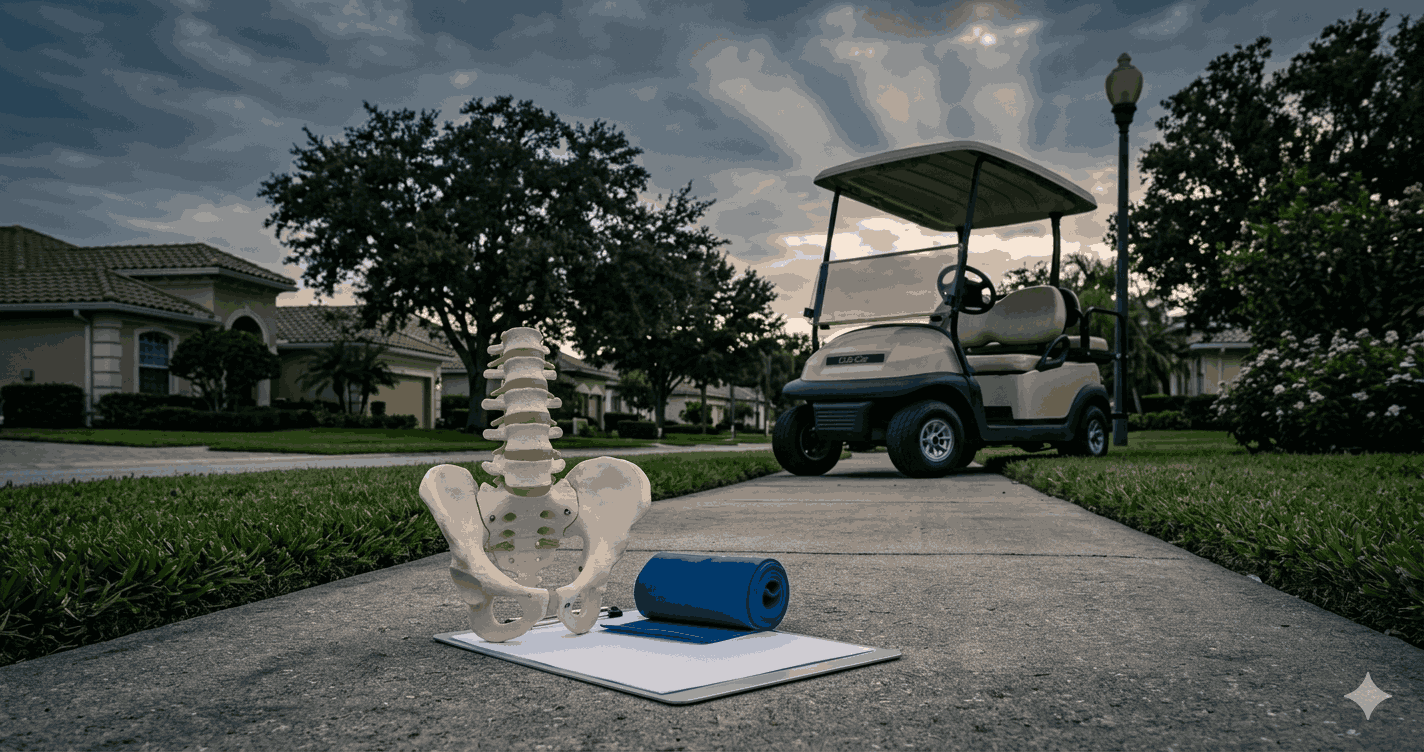
Most people see golf carts as the epitome of low-stress transportation. Whether cruising around a sun-drenched golf course, navigating a gated retirement community, or moving across a sprawling college campus, these open-air vehicles feel entirely benign. Because they typically travel at speeds under 25 miles per hour, we naturally assume the risks are minimal.
Unfortunately, the medical reality tells a completely different story. Golf carts lack the fundamental safety engineering found in standard automobiles, such as airbags, crumple zones, doors, and side-impact beams. When an accident occurs, passengers are often ejected directly onto hard asphalt or concrete.
While a broken bone or severe bruise heals over several weeks, the hidden, long-term effects of golf cart injuries can disrupt a person’s health, career, and quality of life for decades.
Why “Low-Speed” Accidents Cause Permanent Damage
It is easy to fall into the trap of thinking that a crash at 15 miles per hour cannot do permanent damage. However, personal injury data shows that nearly 15,000 golf cart accidents require emergency room visits every single year in the United States alone.
The primary culprit behind long-term complications is vehicle physics:
-
The Pivot Effect: Many golf carts feature basic side hip restraints. When a driver takes a sharp turn too fast, these hip restraints can act as a physical pivot point. Instead of keeping the passenger inside, they cause the upper torso and head to swing violently downward, hitting the ground headfirst.
-
Top-Heavy Design: Golf carts have a narrow track and a high center of gravity, making them remarkably prone to rolling over when cornering sharply or traversing uneven turf.
-
Zero Restraints: Because the vast majority of standard fleet carts do not feature seat belts, passengers have nothing securing them to the vehicle during a sudden impact.
1. Chronic Traumatic Brain Injury Complications
Head injuries make up more than 11% of all golf cart accident traumas, frequently resulting from a passenger’s head directly striking the pavement. While an initial diagnosis might be a “mild concussion,” the long-term effects can morph into Post-Concussion Syndrome (PCS) or chronic neurological deficits.
Cognitive Decline and Memory Loss
Months or even years after the initial impact, victims of a golf cart-related brain injury can struggle with high-level executive functioning. This includes persistent short-term memory loss, difficulty maintaining concentration in noisy environments, and slower mental processing speeds that make returning to a demanding professional career incredibly difficult.
Chronic Post-Traumatic Headaches
A structural blow to the cranium can disrupt local nerve pathways and blood flow. Many survivors report dealing with debilitating, daily tension headaches or migraines that do not respond well to standard over-the-counter pain medications.
Post-Traumatic Seizures
In cases involving severe head trauma, such as skull fractures or intracranial bleeding, the brain tissue can develop microscopic scar tissue. Clinical studies tracking neurosurgical golf cart injuries have noted patients developing post-traumatic seizures up to three months after the initial accident, requiring long-term anticonvulsant medication management.
2. Permanent Orthopedic Alterations and Early Arthritis
Orthopedic trauma is incredibly common in golf cart crashes, with bone fractures accounting for a massive 93% of major skeletal injuries recorded in nationwide emergency department databases. Because these fractures often involve joints, they lay the groundwork for long-term physical limitations.
[Joint Fracture from Ejection] ──> [Cartilage Misalignment] ──> [Accelerated Wear & Tear] ──> [Early-Onset Post-Traumatic Arthritis]
Post-Traumatic Arthritis
When a bone fractures near or through a joint surface—such as the wrist, elbow, or knee—the ultra-smooth cartilage padding is permanently disrupted. Even if a surgeon flawlessly resets the bone with plates and screws, the micro-irregularities in the joint cause accelerated wear and tear. This leads directly to early-onset post-traumatic arthritis, causing chronic pain, stiffness, and reduced mobility by the time the patient reaches mid-life.
Complex Regional Pain Syndrome (CRPS)
Occasionally, a severe limb fracture or deep crush injury during a golf cart rollover damages the localized peripheral nerves. This can trigger Complex Regional Pain Syndrome, a chronic, long-term condition characterized by severe, burning pain, swelling, and extreme sensitivity to touch in the affected arm or leg.
3. Chronic Back Pain and Spinal Instability
The sudden stopping or jerking motions associated with golf cart collisions can wreak havoc on the human spine. Whiplash and lower back strains might seem temporary, but structural spinal changes can last a lifetime.
Accelerated Disc Degeneration
The violent forces of an ejection or a collision can cause the spine’s intervertebral discs to herniate or bulge. A herniated disc can press tightly against spinal nerves, causing chronic, radiating leg pain (sciatica) or numbness. Over time, these compromised discs lose their hydration and height, leading to chronic mechanical back pain and spinal stenosis later in life.
Long-Term Mobility Loss
In severe, catastrophic instances where a golf cart rolls over and pins an occupant beneath its weight, spinal cord lacerations or severe vertebrae fractures can occur. These structural injuries carry an inherent risk of partial or total permanent paralysis, entirely altering the victim’s lifelong independence.
Comparative Long-Term Impact of Common Injuries
To understand how various golf cart traumas shift from acute medical issues into permanent life changes, review this structured breakdown:
| Initial Injury | Potential Long-Term Complication | Expected Lifetime Impact |
| Concussion / Mild TBI | Post-Concussion Syndrome, memory deficits, chronic migraines. | High cognitive strain; may require long-term neurocognitive therapy. |
| Intracranial Hemorrhage | Scar tissue formation on brain tissue, post-traumatic epilepsy. | Requires ongoing neurological monitoring and daily anticonvulsant medications. |
| Intra-articular Fracture | Joint cartilage wear, post-traumatic osteoarthritis. | Chronic daily pain, limited range of motion, potential joint replacement surgery. |
| Severe Whiplash / Strain | Chronic cervical myofascial pain syndrome, disc herniation. | Ongoing physical therapy needs, dependence on pain management solutions. |
Step-by-Step Guide to Minimizing Long-Term Damage
If you or a loved one is involved in a golf cart accident, taking an active, structured approach to your medical recovery during the first few weeks can significantly reduce the likelihood of developing permanent, chronic health issues.
1.Insist on Comprehensive Imaging:Identify Hidden Issues.
Actionable Safety Changes to Prevent Lifelong Harm
Preventing a lifetime of chronic pain or cognitive struggles comes down to abandoning the casual mindset often associated with golf carts. Implementing minor, proactive safety changes can eliminate the vast majority of catastrophic outcomes.
-
Retrofit Aftermarket Seat Belts: If your personal or neighborhood golf cart does not have seat belts, purchase a 3-point seat belt kit. Research shows that utilizing seat belts drastically reduces passenger ejections, protecting you from the primary cause of long-term disability and head trauma.
-
Enforce Strict Speed Limits on Turns: Drivers must treat curves with extreme caution. Slow down significantly before entering a turn rather than during it to avoid rolling the vehicle or launching a passenger outward.
-
Keep Extremities Fully Enclosed: Passengers should always ride with both feet flat on the floorboard and their hands firmly gripping the interior grab handles. Never allow children to sit on lap positions or stand up while the cart is moving.
Ultimately, while golf carts provide wonderful utility and casual convenience, they are still heavy motorized vehicles capable of delivering life-altering forces in a collision. By treating them with the same safety respect as a standard car, you can enjoy the ride without putting your long-term health on the line.
Have you or someone in your community ever struggled with long-term stiffness or pain after a minor golf cart tumble? What safety regulations do you think neighborhoods should enforce? Share your thoughts and stories in the comments below, and pass this guide along to your friends to help raise safety awareness!
References
-
Surgical Neurology International (2024). Golf cart-related neurosurgical injuries: Mechanisms of ejection and long-term seizure risks.
-
American Academy of Orthopaedic Surgeons (AOAO) (2023). Nationwide golf cart-related orthopedic injuries: Analysis of long-term skeletal morbidity.
-
Traffic Injury Prevention Journal (2021). The efficacy of 3-point seatbelts in reducing permanent disability from low-speed vehicle ejections.
