
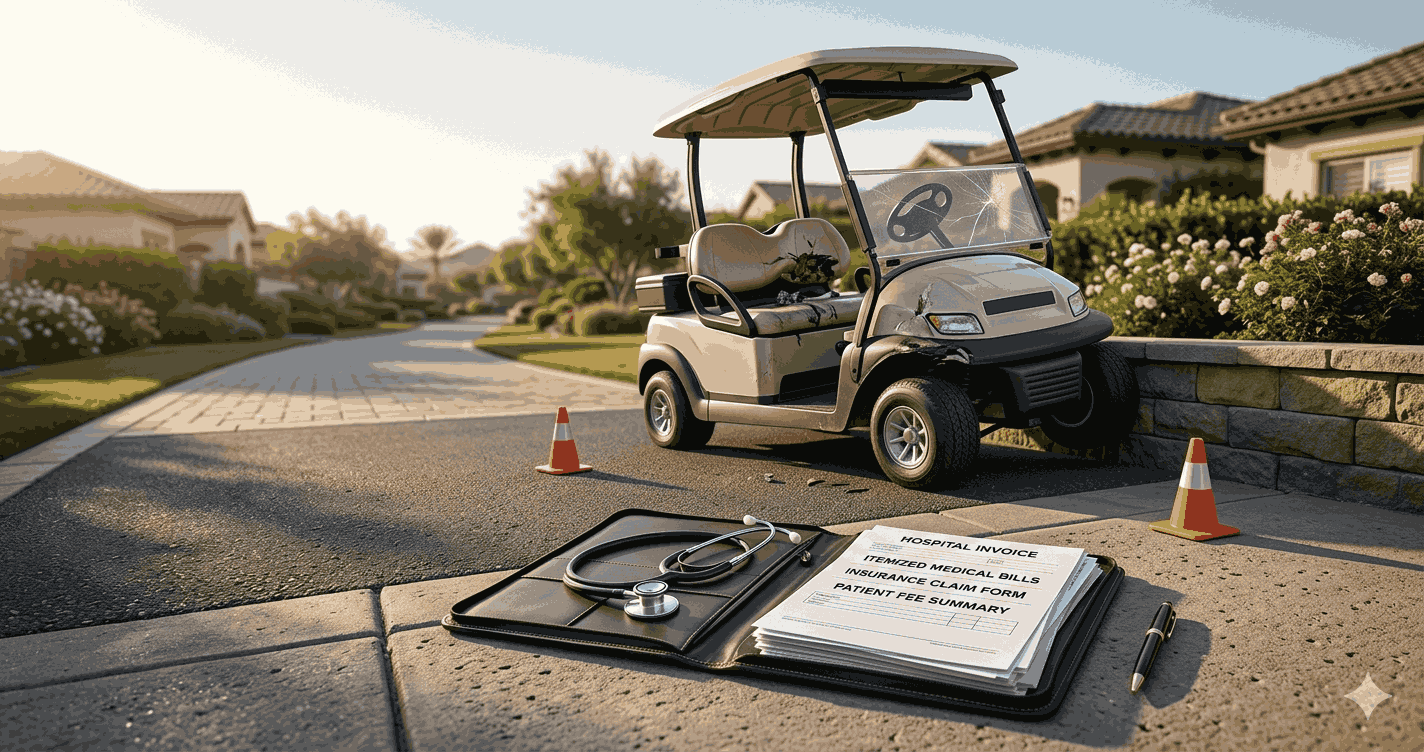
A relaxing weekend ride or a quick trip across a retirement community can change in a split second. While golf carts offer a convenient way to get around, collisions or roll-overs often leave passengers facing unexpected, painful injuries. Once the initial shock wears off and medical treatment begins, another major stressor quickly arrives in the mailbox: medical bills.
Navigating healthcare costs after a golf cart incident is uniquely complicated. Unlike standard car accidents, which follow a predictable insurance path, golf carts fall into a legal gray area. Knowing who pays, which insurance policy applies, and how to protect your finances can save you from overwhelming debt.
Why Golf Cart Medical Bills Can Pile Up Quickly
Many people underestimate the physical impact of a golf cart crash. Because these vehicles usually lack airbags, doors, and standard crumple zones, even a low-speed impact forces the human body to absorb the brunt of the collision.
Common injuries that lead to expensive medical billing include:
-
Soft Tissue Damages: Severe whiplash, torn shoulder ligaments, and deep muscle contusions from bracing against the cart’s frame.
-
Bone Fractures: Broken wrists, ankles, and collarbones caused by ejections onto hard asphalt or concrete paths.
-
Head and Brain Injuries: Concussions or more severe traumatic brain injuries (TBIs) when a passenger hits the ground headfirst.
Between emergency room fees, diagnostic imaging like MRIs, specialized orthopedic surgeries, and weeks of physical therapy, the total cost can easily range from a few thousand dollars to well over six figures.
The Insurance Puzzle Who Pays the Medical Bills First
After a traditional car crash, auto insurance coverage is clear-cut. However, after a golf cart accident, multiple insurance companies often point fingers at each other, trying to avoid paying the bills.
To determine who is responsible for your medical expenses, you must look at several potential insurance avenues.
1. Health Insurance Coverage
Your primary health insurance policy is usually the first line of defense. Whether you have private insurance, an employer-sponsored plan, Medicare, or Medicaid, it will cover your initial emergency room treatment, surgeries, and doctor visits.
However, you are still responsible for your standard deductibles, co-pays, and out-of-pocket maximums. Furthermore, your health insurance company will likely keep a close eye on the case. If they find out another party caused the accident, they will attempt to recover what they paid through a legal process called subrogation.
2. Specialized Golf Cart Insurance
Some owners purchase specific recreational vehicle policies for their golf carts. If the owner has a dedicated policy, it may include Medical Payments (MedPay) or Personal Injury Protection (PIP) coverage.
MedPay or PIP is incredibly valuable because it pays for your immediate medical bills regardless of who caused the accident. This coverage typically ranges from $1,000 to $10,000, providing a helpful buffer for immediate out-of-pocket expenses.
3. Homeowners Insurance Policies
A common misconception is that a basic homeowners insurance policy automatically covers any golf cart accident. In reality, most standard homeowners policies only provide coverage under very strict limitations:
-
The accident must occur directly on the property owned by the policyholder.
-
The cart must be used primarily to maintain the property.
If the accident happens on a public street, a community path, or a golf course, a standard homeowners policy will almost certainly deny the claim. However, if the owner purchased an explicit “golf cart endorsement” or rider for their homeowners policy, coverage may extend to off-property incidents.
4. Auto Insurance Coverages
In most states, standard auto insurance policies do not cover accidents involving golf carts because golf carts do not meet the legal definition of a “motor vehicle.”
However, there is a major exception: if a traditional passenger car or truck strikes your golf cart on a public road, the at-fault driver’s auto liability insurance will be responsible for your medical bills, property damage, and pain and suffering.
How Liability Affects Medical Bill Compensation
While your health insurance handles immediate billing, the ultimate financial responsibility depends entirely on who caused the accident. Determining fault dictates which liability policy must ultimately pay out a settlement to cover your losses.
Scenario A: You Were a Passenger in a Careless Friend’s Cart
If you were riding as a passenger and the driver took a sharp turn too fast, causing you to fly out, the driver is legally liable. In this case, you would file a claim against the driver’s specialized golf cart insurance or their homeowners policy endorsement. While it can feel uncomfortable to file a claim against a friend or neighbor, remember that you are dealing with their insurance company, not taking money out of their pockets.
Scenario B: You Were Hit by Another Reckless Driver
If another golf cart operator drives recklessly and crashes into you, their personal liability insurance is responsible. Your medical bills will be submitted to their insurance carrier as part of a third-party personal injury claim.
Scenario C: The Accident Happened at a Commercial Resort or Country Club
If your crash was caused by a mechanical failure such as worn-out brakes on a rented cart or a poorly maintained, hazardous pathway, the facility itself may be liable. In this situation, the commercial property’s premises liability insurance will become the primary source for your medical bill compensation.
Step-by-Step Guide to Managing Bills After an Accident
When medical bills start arriving, organization is your best weapon. Failing to manage the paperwork correctly can damage your credit score or hurt your chances of a fair legal settlement.
1.Seek Immediate Medical Care:Establish a Baseline.
The Role of a Personal Injury Lawyer in Maximizing Payouts
If your medical bills are substantial, handling the insurance companies on your own can be an uphill battle. Adjusters often try to offer quick, lowball settlements before you fully understand the total cost of your long-term medical care.
An experienced personal injury attorney helps protect your financial future by:
-
Investigating the Incident: Gathering accident reports, interviewing witnesses, and identifying every available insurance policy that might apply.
-
Calculating Future Medical Costs: Working alongside your doctors to estimate the costs of any future surgeries, medications, or ongoing physical therapies you will need.
-
Negotiating Liens: If your health insurance company places a lien on your final settlement to get reimbursed, a lawyer can often negotiate with them to lower the amount they take, leaving more money in your pocket.
Practical Safety Steps to Protect Your Wallet and Health
The most effective way to avoid overwhelming medical bills is to prevent severe injuries from happening in the first place. Practicing basic safety protocols protects both your body and your financial well-being.
-
Insist on Seat Belts: If your golf cart or low-speed vehicle has seat belts, use them every single time. They prevent ejections, which are the leading cause of high-cost head and spine injuries.
-
Verify Your Insurance Coverage: Call your insurance agent today. Ask if your current homeowners or auto policy covers golf cart operations off your private property. If it doesn’t, consider purchasing a standalone recreational vehicle policy.
-
Drive Defensively: Treat a golf cart like a car. Slow down significantly before entering any turns, avoid distracted driving, and never operate a cart under the influence of alcohol.
Have you ever had to deal with confusing medical bills after an unusual vehicle accident? What strategies helped you stay organized? Share your experiences or ask a question in the comments below, and don’t forget to share this article with your neighbors to keep your community safe and informed!
References
-
Surgical Neurology International (2024). Analysis of neurosurgical trauma and mechanisms of injury in low-speed recreational vehicle accidents.
-
Pediatric Emergency Care (2025). Evaluation of pediatric morbidity and healthcare utilization following golf cart incidents.
-
Trauma Surgery & Acute Care Open (2024). Trends in head trauma and public safety regulations regarding low-speed vehicles.
