
When a golf cart accident occurs on private property—such as in a gated community, at a resort, or on a large residential estate—many people assume that standard road rules or insurance policies do not apply. In Florida, however, the legal implications can be just as significant as an accident on a public street. Understanding your rights and responsibilities is essential if you find yourself involved in such an incident.
Liability and the “Dangerous Instrumentality” Doctrine
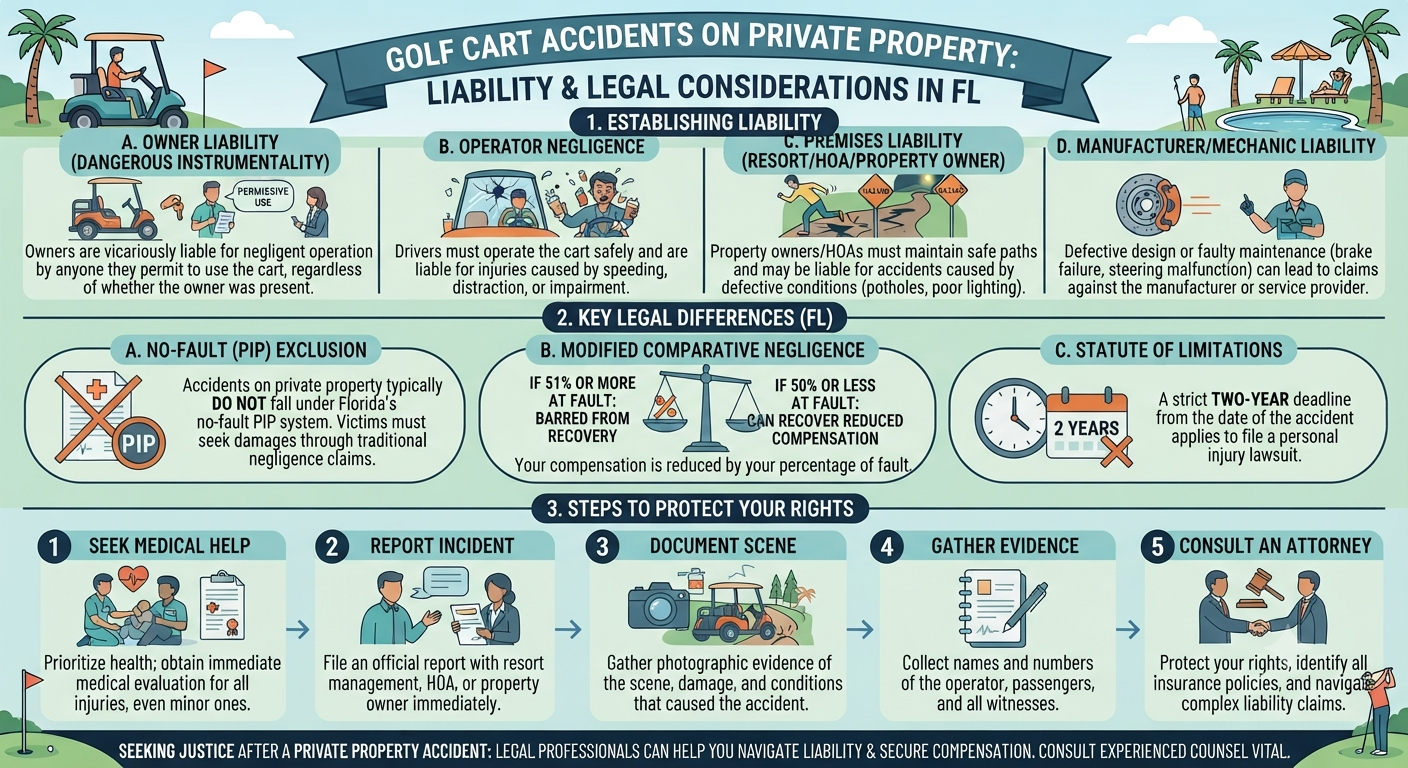
One of the most critical aspects of Florida law regarding golf carts is the Dangerous Instrumentality Doctrine. Under this common law doctrine, Florida courts treat golf carts as inherently dangerous instrumentalities, similar to motor vehicles.
-
Owner Liability: If you own a golf cart and permit someone else (a friend, renter, or relative) to operate it, you can be held vicariously liable for any injuries they cause due to their negligence.
-
Strict Liability: This is a form of strict liability, meaning the injured party does not need to prove that you were negligent in lending the cart; if you gave permission and the driver caused an accident, liability attaches to you automatically.
-
Permission: Permission can be express or implied. For example, routinely leaving keys accessible to a household member who frequently uses the cart can be viewed as implied consent.
The Insurance Gap
A common misconception is that standard insurance policies will cover any accident involving a golf cart, regardless of location. In reality, golf cart coverage is often complex and highly specific.
-
Homeowners’ Policies: While some homeowners’ insurance policies may cover golf carts, many explicitly exclude motorized vehicles or only provide coverage when the cart is used on the insured’s own premises.
-
Auto Policies: Standard auto insurance policies often do not cover golf carts because they are not designed for regular road use. Unless the cart is specifically listed on your policy or you have purchased a dedicated golf cart insurance policy, you may find yourself without coverage.
-
LSV vs. Golf Cart: If the vehicle is classified as a Low-Speed Vehicle (LSV)—meaning it can reach speeds of 20–25 mph—it must be registered and insured with Personal Injury Protection (PIP) and Property Damage Liability (PDL). Standard golf carts do not have these same mandates, often leaving victims without a clear path to recovery if they are injured.
Potential Defendants in Private Property Claims
Liability in private property accidents is rarely limited to just the driver. Depending on the circumstances, potential defendants may include:
-
Property Owners/HOAs: If poor trail design, inadequate lighting, missing signage, or hazardous path conditions contributed to the accident, the homeowners’ association or property owner may face a premises-liability claim.
-
Rental Companies: If a resort or rental business provided a cart with known mechanical defects (e.g., faulty brakes or bald tires) or entrusted it to an unfit driver, they can be held liable.
-
Manufacturers: If a mechanical failure, such as a steering collapse or battery fire, caused the crash, you may have grounds for a product liability claim.
Steps to Protect Your Rights
If you are involved in a golf cart accident on private property, your actions in the immediate aftermath are vital to protecting your legal claim:
-
Seek Immediate Medical Attention: Even if you feel “fine,” adrenaline can mask serious soft-tissue or head injuries. Always obtain a professional medical evaluation.
-
Report the Incident: Ensure an official report is filed with the property manager, security, or the appropriate authorities.
-
Document Everything: Take photographs of the cart, the site of the accident, any visible injuries, and any hazardous conditions that may have contributed to the crash.
-
Gather Evidence: Collect contact information for all witnesses and the driver involved.
-
Consult an Attorney: Because of the complexities surrounding Florida’s insurance exclusions and liability doctrines, it is wise to consult a personal injury attorney who can evaluate your policy and identify all potential sources of compensation.
References
-
Salter, Healy, Rivera, & Heptner. What To Do After a Golf Cart Accident in Florida. (2025).
-
Florida Department of Highway Safety and Motor Vehicles. Golf Carts, Low Speed Vehicles and All-Terrain Vehicles.
-
Florida Supreme Court. Dangerous Instrumentality Doctrine Precedents.
-
Alper Law. Florida’s Dangerous Instrumentality Doctrine: Vehicle Owner Liability for Car Accidents.
-
Swoper Law. Florida Statute of Limitations for Personal Injury (2026 Update).
-
DeLoach, Hofstra & Cavonis, P.A. How long do I have to file a personal injury lawsuit in Florida?
-
Sunset Watersports. Do You Need Insurance to Rent a Golf Cart in Key West?
-
Joyride.city. Why golf cart fleet insurance is a huge hurdle for operators.
-
King Law Firm. Injured in a Golf Cart Accident? Here’s How the Law Applies. (2026).
-
Rushing & Guice. What do I do if I am Injured in a Golf Cart Accident?
